

The U.S. ten-year Treasury yield stood at 5.01% on Friday, while the thirty-year reached 5.34%. Earlier in the week, the Federal Reserve raised its policy rate by 25 basis points to 3.75–4.00%. Short-term policy and long-term financing costs are different things, but neither is offering much relief to borrowers.
There is nothing magical about 5%. The significance is what it asks of every investment competing with it. A higher government-bond yield raises the starting point for assessing dollar-denominated investments. Investors still need compensation for business risk, illiquidity and execution. Strong growth can justify paying more, but only if enough of that growth survives the cost of financing it.
This is not a straightforward instruction to buy bonds. A ten-year Treasury is not cash: its market value can fall if yields rise further, and inflation can erode its purchasing power. The relevant comparison is between risks and prospective returns, not headline yields alone.
For companies, the adjustment will arrive unevenly. Fixed-rate debt and hedging can delay the impact. Floating-rate borrowers feel it sooner. Businesses refinancing next year may face a different economic reality from competitors whose funding is secured for another five.
The same distinction applies to new investment. A project can have genuine customer demand and still struggle to earn an adequate return after construction costs, interest and delays. Better operating performance does not automatically rescue an investment made at the wrong price.
The question is not simply which companies can keep growing. It is which can finance that growth without weakening the return to shareholders. Debt maturities, interest coverage and cash generation deserve as much attention as revenue forecasts. At 5%, the alternative use of capital is harder to ignore.
Macro
Public Markets
M&A
Staying Diligent
Things we are watching: 21–25 September
Calendar and analysis as of 20 September; publication 22 September.
The Unhedged View
China's chip progress still has to pass the cost test.
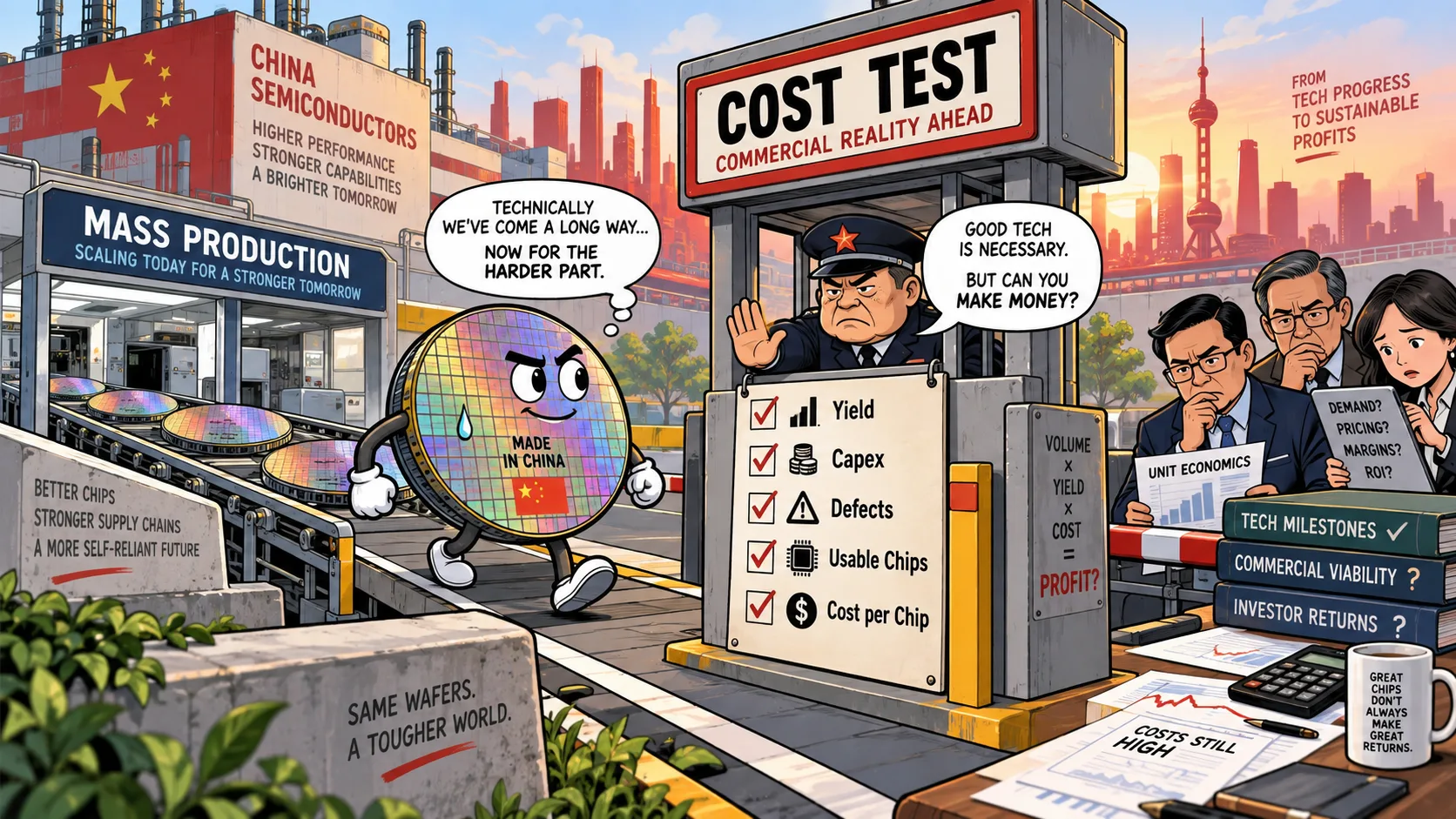
China's CXMT said on Sunday that its fifth-generation memory-chip platform had entered mass production. The company claims at least 50% more gross chip dies per wafer than its previous generation. That is output before defective chips are excluded, not a verified 50% increase in usable production. That distinction is where the investment argument begins.
The announcement comes while U.S. export controls restrict access to certain advanced manufacturing equipment and software. Continued technical progress and continuing constraints can therefore coexist. One product announcement cannot establish either that restrictions have stopped progress or that their effects have been overcome.
For investors, the more useful question is what that progress costs. A manufacturer can demonstrate a smaller feature size without demonstrating a lower cost per working chip. Additional production steps, defective output, testing requirements and equipment utilisation all affect the economics. A more advanced process is valuable only if customers can obtain qualified products reliably and at a competitive price.
This creates two separate tests. The first is technological: can the company produce the chip? The second is commercial: can it repeatedly produce enough usable chips, secure customer approvals and earn an acceptable return on the capital invested?
Neither should be confused with complete supply-chain independence. Nor should a constrained production process automatically be dismissed as commercially irrelevant. The answer depends on actual operating results.
CXMT's announcement deserves attention, but the next evidence should come from reliable shipments, customer adoption and manufacturing economics. The competitive implications will be clearer when those measures accompany the technical milestones. The important number is not simply the manufacturing generation. It is the cost of a chip that works.
In Other News

One millisecond. Days of disruption.
A preliminary NATS report published on 18 September traced Britain's air-traffic disruption on 8 September to a software defect triggered during a sequence of operations lasting around a millisecond. More than 2,000 flights were delayed, cancelled or diverted.
A request to allocate an aircraft identification code was interrupted by a higher-priority process. When it resumed, the defect corrupted information used by controllers. Traffic restrictions followed to maintain safety.
NATS operations returned to normal that evening. Clearing the passenger backlog took more than two days. NATS said safety was maintained throughout.
That gap is the important part. Restoring a system is not the same as restoring the service built around it. Aircraft, crews and passengers still need to be in the right places. A technical restart does not erase the work accumulated while the system was unavailable.
Businesses often measure resilience by how quickly their technology can recover. Customers experience something different: how long it takes to receive the service they were promised.
The distinction changes what a useful contingency plan should test. Can the business operate at reduced capacity? Can it manage the backlog? Can suppliers and customers recover alongside it? Preventing the next software defect matters. So does limiting how far one defect can spread.
The lesson: measure recovery from the customer's side of the system. The dashboard may be green while the departure board is still red.
The Thinking Corner
When an investment depends on financing, technology and infrastructure all working as expected, how should we identify which assumption could fail first, and whether the expected return adequately compensates us for that risk?
Latest from the team
Market commentary and field notes from the team, on The Felix View.