
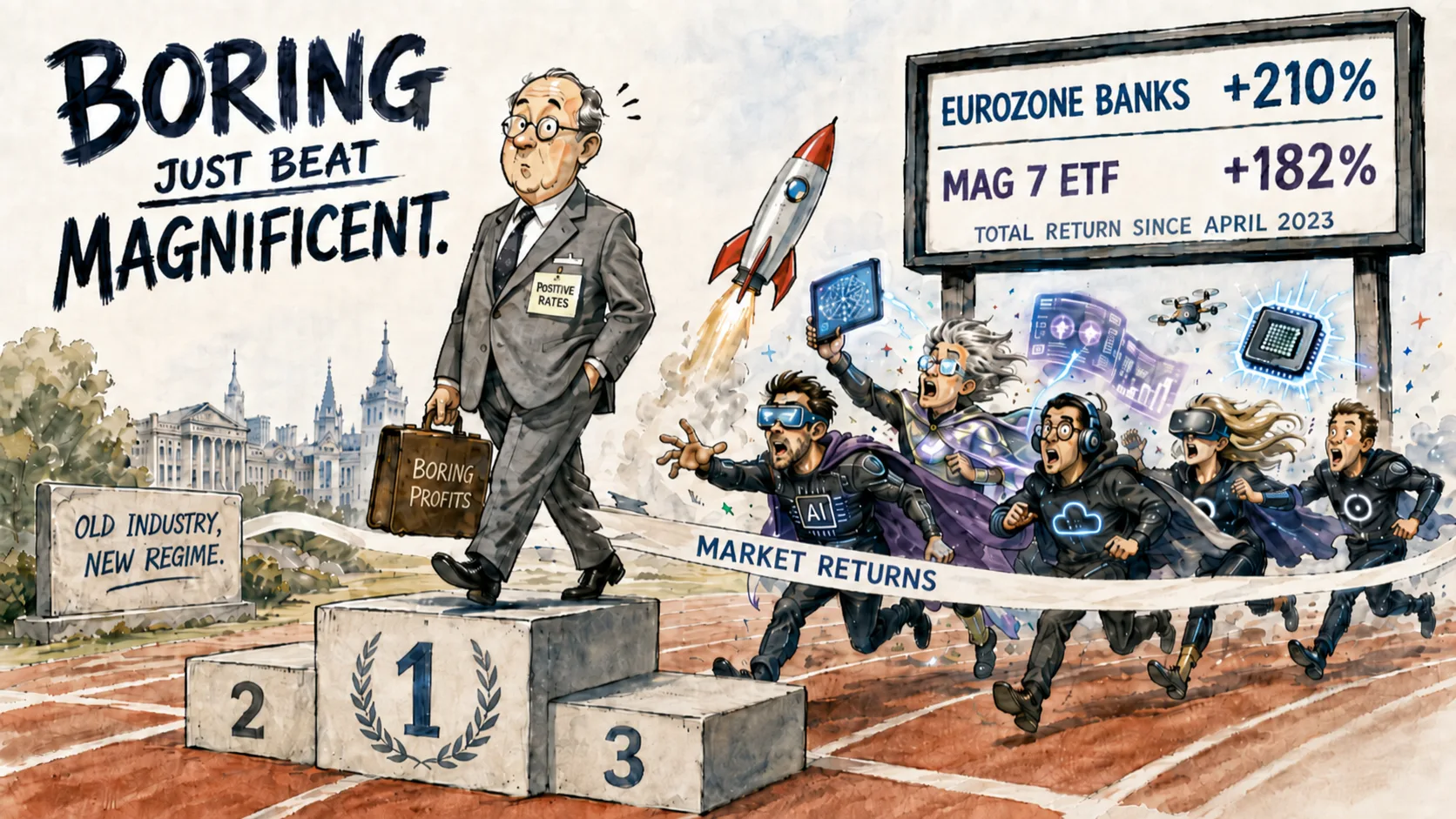
For years, the investment case for Europe has been framed by what it does not have. No Nvidia. No Amazon. No Meta. No obvious answer to the Magnificent Seven. It turns out Europe may not have needed one.
Since the Roundhill Magnificent Seven ETF launched in April 2023, it has risen roughly 182%. Over the same period, the main eurozone bank index has gained almost 210%. For a dollar-based investor, currency movements push the return from European banks closer to 225%.
The winners are hardly obscure. UniCredit has risen more than 350%, Santander and BBVA around 280%, while ING and Intesa Sanpaolo have also delivered exceptional returns. There was no revolutionary technology behind it.
The biggest change was much simpler: interest rates became positive again. After more than a decade in which European banks struggled with compressed margins, negative rates and anaemic returns, the operating environment changed. Net interest income recovered, balance sheets improved, capital distributions increased and businesses investors had largely written off became highly profitable again.
There is a useful lesson here. Markets naturally gravitate towards exciting stories. AI, space, robotics and biotechnology offer enormous addressable markets and the possibility of creating entirely new industries. But investment returns do not require a new industry. Sometimes they require an old industry entering a better regime.
Innovation creates extraordinary companies. But markets occasionally become so focused on finding the next new thing that they miss something simpler: an old business with newly attractive economics. Sometimes boring is exactly where the opportunity is.
Macro
Public markets
M&A
Staying Diligent
Things we are watching this week: 17–21 August
Unhedged Commentary
Deregulation, with a passport check.
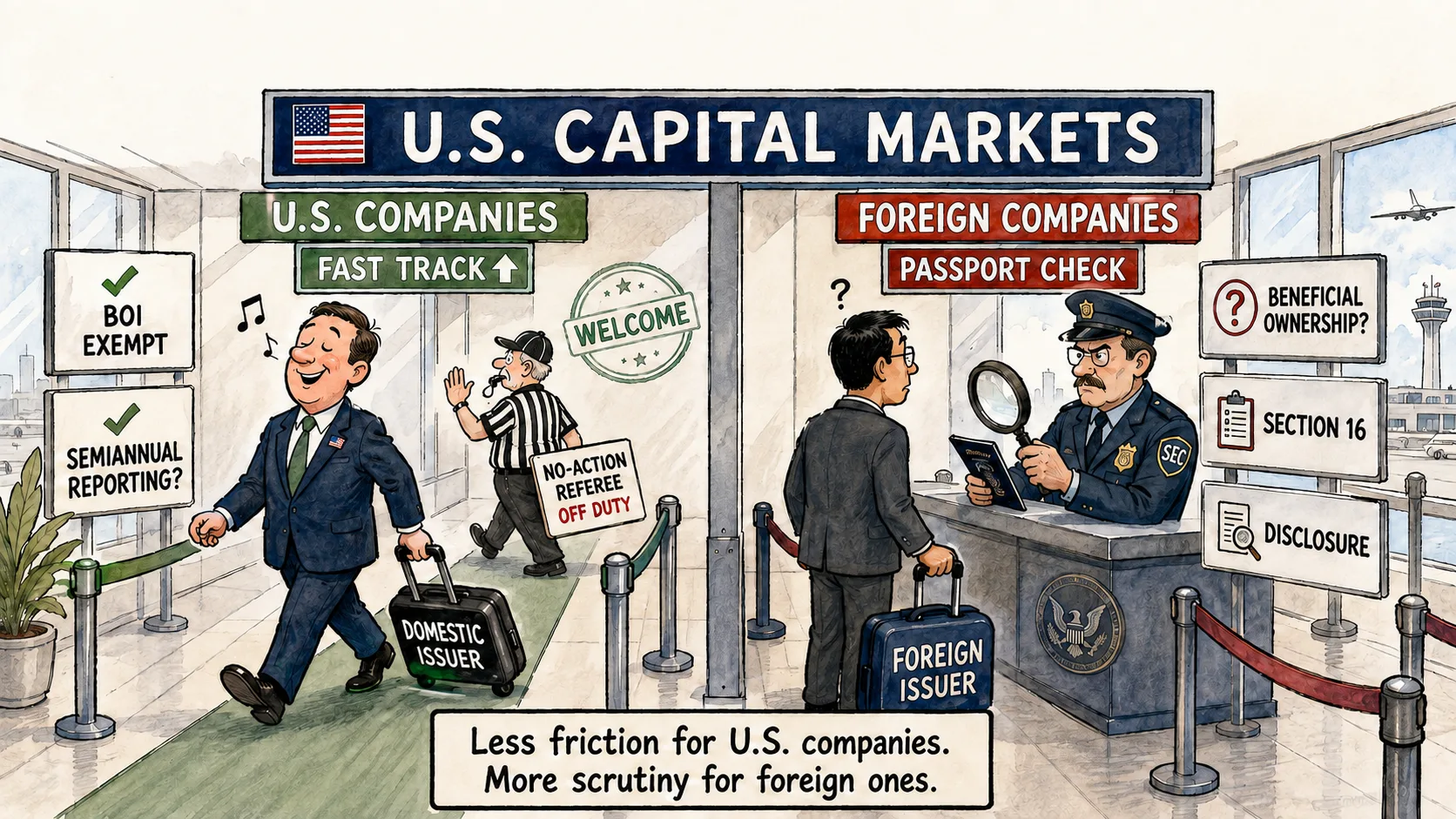
America is cutting corporate red tape. But increasingly, it matters where your company comes from. Since March 2025, U.S.-created companies have been exempt from federal beneficial-ownership reporting requirements. Certain foreign companies operating in the U.S. can still be required to disclose who ultimately owns them.
That is a notable shift. Rules originally designed to increase corporate transparency now apply differently depending on where a company was created. And it is part of a broader direction.
In May, the SEC proposed allowing U.S. listed companies to report financial results twice a year rather than every quarter, arguing that lower compliance costs could make public markets more attractive.
More recently, the SEC also stepped back from routinely deciding whether companies can exclude certain shareholder proposals from their annual meeting materials. Again, the direction is towards giving companies more flexibility and reducing regulatory involvement.
This does not mean America is abandoning transparency. Foreign-listed companies already operate under different reporting rules, and in some areas scrutiny of foreign companies and executives is actually increasing.
The bigger picture is more interesting. Washington appears to be asking: how can we make it easier to start, run and list a company in America without giving up control over foreign ownership and influence?
That is not simply deregulation. It is regulatory competition. The U.S. wants companies to incorporate there, raise capital there and stay public there. If that means fewer forms, fewer mandatory updates and less regulatory intervention, policymakers increasingly seem willing to make that trade.
The risk, of course, is that cutting unnecessary paperwork eventually becomes cutting useful information. Investors benefit from transparency, and fewer reporting requirements can also mean fewer opportunities to spot problems early.
America is not simply removing rules. It is trying to make its corporate and capital markets more competitive, while keeping a closer eye on foreign participants. Deregulation is coming. Just remember to bring your passport.
In Other News
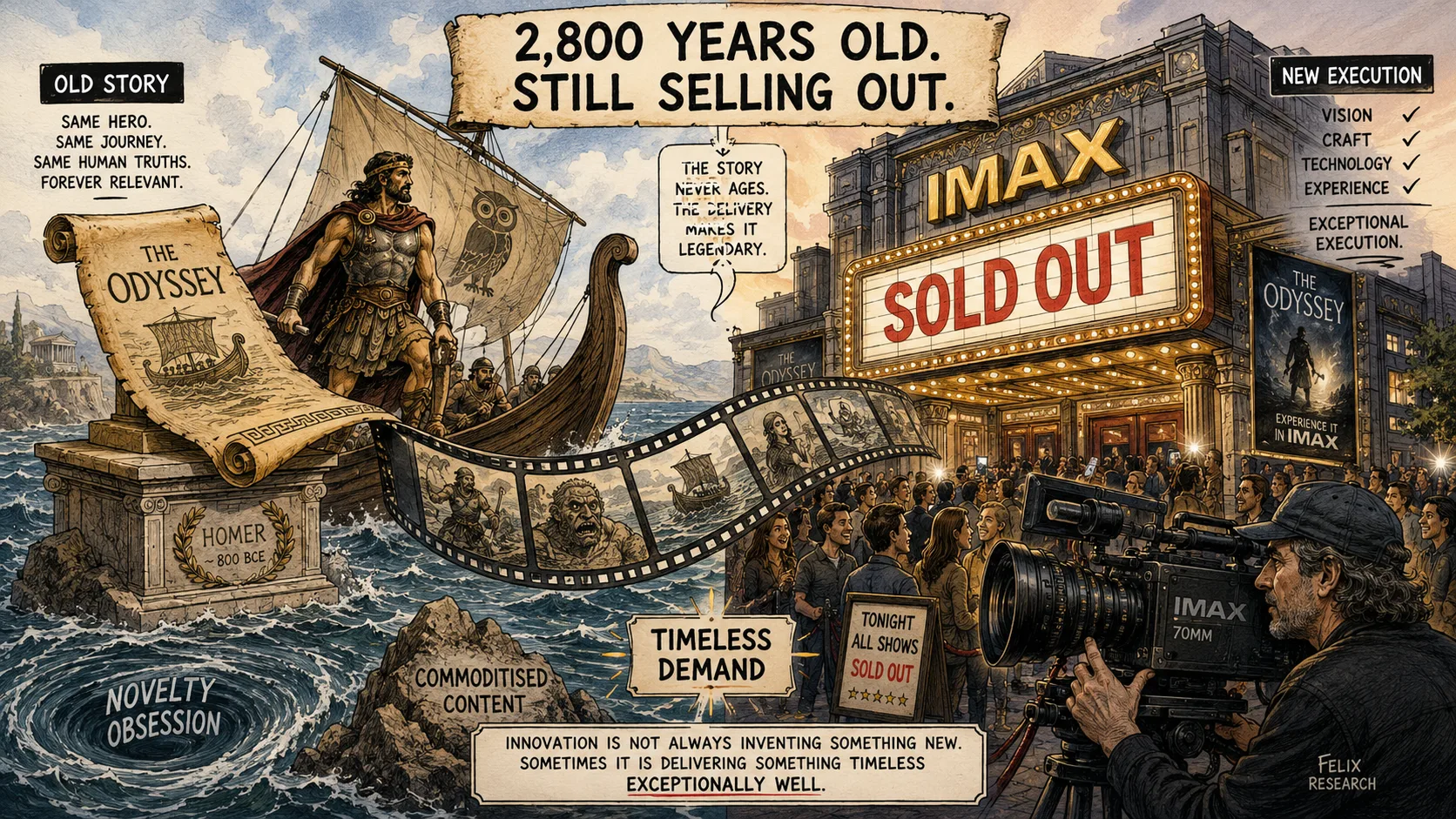
2,800 years old. Still selling out.
Christopher Nolan's latest blockbuster did not begin in a writers' room or an algorithm searching for the next franchise — it began almost 2,800 years ago.
Homer's Odyssey is one of the oldest stories in Western literature, yet Nolan's adaptation generated $264m globally during its opening weekend, his strongest worldwide opening to date. It was also the first feature filmed entirely with IMAX cameras and helped deliver IMAX's highest-grossing month on record.
None of this came from inventing a new story. It came from taking an old one seriously. Businesses are often obsessed with novelty: new products, new technologies, new categories and new markets. But novelty and value are not the same thing.
An idea does not become irrelevant simply because customers recognise it. Familiarity can create trust, emotional connection and immediate understanding. The real challenge is making something familiar feel important again.
Nolan did not merely retell The Odyssey. He combined a timeless story with modern technology, scale and exceptional execution. The story is old. The experience is new. This distinction matters beyond cinema. Smartphones did not invent communication. Streaming did not invent music. Digital banking did not invent saving or payments. They improved how familiar needs were served.
The future does not always belong to the newest idea. Sometimes it belongs to the oldest idea, finally executed properly.
The Thinking Corner
When an old industry starts outperforming the market and a new technology promises to reshape it, how should investors separate genuine structural change from a temporary shift in the environment?
Latest from the team
Market commentary and field notes from the team, on The Felix View.