

Europe's latest energy stress test is not coming from gas storage, LNG cargoes or another pipeline shock. It is coming from lack of water.
Drought and low river levels are turning a climate issue into a power-market problem. Nuclear plants need cooling water, hydropower depends on inflows and thermal plants lose efficiency in extreme heat. Fuel deliveries sometimes rely on navigable rivers. At the same time, heatwaves raise electricity demand just as parts of the supply stack become less reliable.
Hungary and Romania offer the clearest warning. The Paks nuclear plant has faced output reductions because the Danube has fallen too low to support normal cooling. Cernavoda has experienced similar pressure. The lesson is simple: even low-carbon baseload power can carry meaningful climate risk when it depends on increasingly volatile river systems.
Europe is also discovering that energy security is no longer purely national. Cross-border imports, including flows from war-hit Ukraine, are becoming part of the resilience toolkit. That shows the value of grid integration, but also the fragility of a system in which climate stress, geopolitics and infrastructure are increasingly intertwined. Europe is used to worrying about winter gas. It now also needs to worry about summer electricity. Heat increases cooling demand, drought reduces generation flexibility and wholesale prices can rise during periods that were once relatively benign.
Energy-intensive users may face higher prices, demand reductions or rationing risk. Low river levels can also restrict cargo volumes on the Rhine and Danube, raising costs across chemicals, manufacturing, agriculture, construction materials and fuel supply chains.
For infrastructure investors, the key lesson is that weather risk can no longer sit in the ESG appendix. It belongs in the base case. Underwriting must take greater account of hydrology, cooling-water access, heat-related derating, river logistics, network congestion and locational exposure. A power asset can be low carbon and still be climate fragile. Asset selection should also shift towards flexibility. Batteries, demand response, interconnectors, grid reinforcement, storage optimisation and digital grid tools become more valuable as weather volatility drives price volatility. The relevant question is no longer simply: "What is the cheapest megawatt-hour?"; it is: "What keeps the system functioning when the weather stops behaving?"
Europe needs more than additional renewable capacity. It needs a more resilient electricity architecture: stronger grids, more storage, better cross-border connections, upgraded cooling systems and planning assumptions that reflect hotter, drier and more volatile environmental conditions. The assets that will outperform are not necessarily the greenest. They are the ones that still work when the rivers run low.
Macro
Public markets
M&A
Staying Diligent
Things we are watching this week: 10–14 August 2026
Unhedged Commentary
China is not dumping the dollar. It is buying insurance.
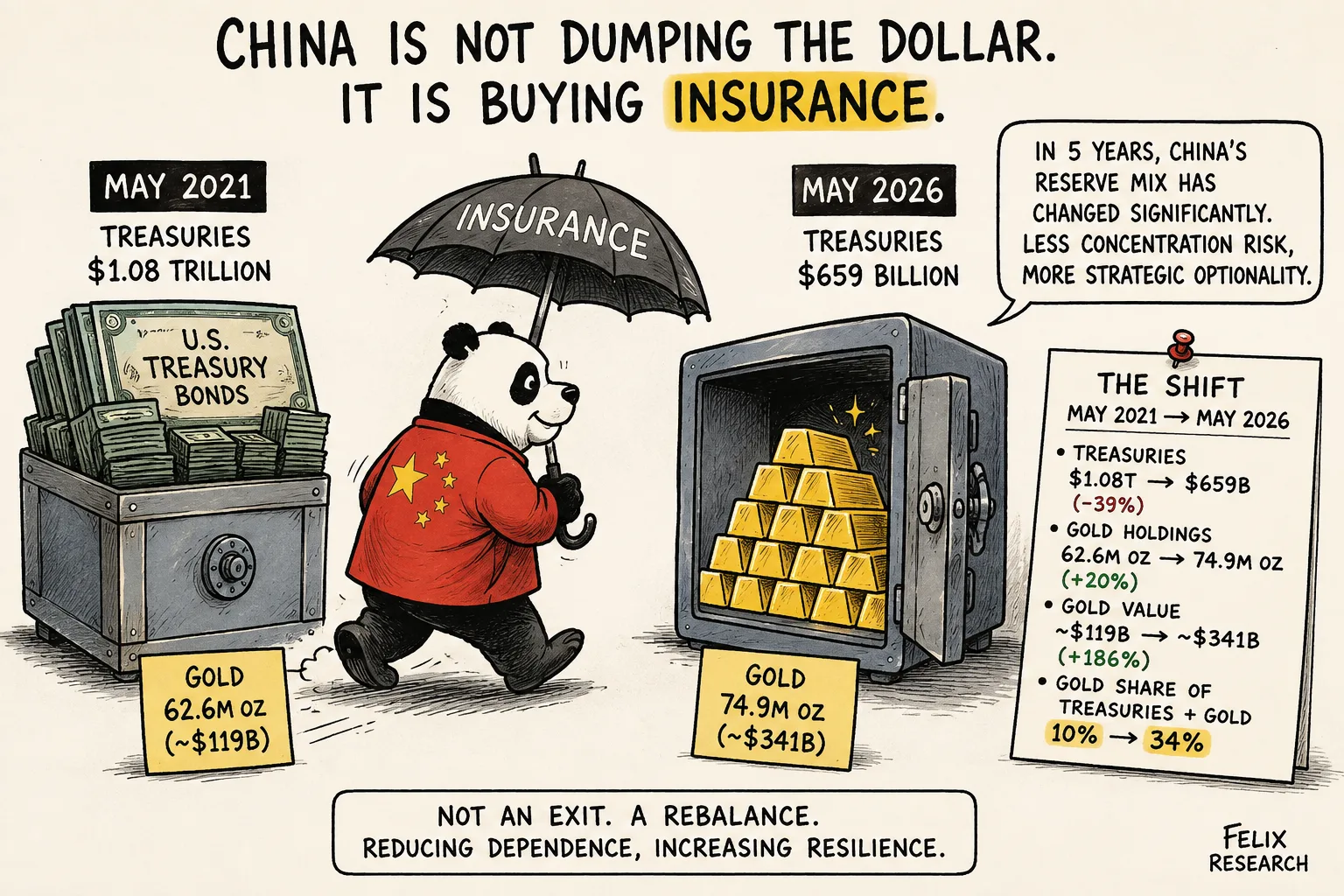
China's move away from U.S. Treasuries and towards gold is often described as "de-dollarisation". The numbers suggest something more gradual: a deliberate reduction in concentration risk.
Over the five years to May 2026, China's reported holdings of U.S. Treasuries fell from approximately $1.1tn to $659bn, a decline of nearly 39%. Over the same period, its official gold holdings rose by around 20%, from 62m to 75m ounces. Higher gold prices amplified the shift. The value of China's gold reserves increased from roughly $119bn to $341bn. In 2021, China held about $9.10 of Treasuries for every $1.00 of gold. Five years later, that ratio had fallen to around $1.90.
This is not an abandonment of the dollar. But the geopolitical context has changed. Trade restrictions, sanctions and the freezing of Russian central-bank assets have shown that reserves held inside another country's financial system can carry political as well as financial risk.
Gold offers something different. It has no sovereign issuer, does not depend on U.S. fiscal or monetary policy and, when stored domestically, is harder to restrict through foreign financial infrastructure. China is therefore not replacing Treasuries with gold one-for-one. The two assets serve different purposes: treasuries provide liquidity and income; gold provides independence and crisis protection.
For the United States, the risk is not a sudden Chinese sell-off. It is the gradual erosion of the automatic official-sector demand that has historically helped absorb Treasury issuance. For China, the objective is resilience: less dependence on U.S. financial infrastructure without attempting a destabilising break from the dollar system.
China is not dumping the dollar. It is reducing its reliance on it and buying insurance against a world in which financial reserves are increasingly political.
In Other News

A $965bn question, a $1tn shortcut and a $15mn moonshot.
Three stories this week capture the AI trade's next phase better than any index level.
The question. Anthropic is meeting potential investors ahead of a planned IPO that could launch in September or early October — and could be the largest of all time. Investors are pressing the $965bn company on cheaper Chinese models, tensions with the Trump administration and a growing backlash against data-centre construction. Its coding tool has made Anthropic the front-runner in the AI race; it has also made Silicon Valley nervous about how much power one company now holds. The price it sets will establish how public investors value the frontier labs — and trillions of dollars of AI infrastructure spending rest on the answer.
The shortcut. The WSJ this week worked through the arithmetic of a Tesla–SpaceX merger. Buried in Musk's $1tn pay package is an escape clause: if SpaceX acquires Tesla, key performance targets fall away instantly. At a $2tn offer price, Musk would receive 35 million shares on completion and own roughly 32% of the combined company. As one accounting professor put it: "This $1 trillion — that was supposed to be a stretch. It turns out it isn't really that hard. All you have to do is be bought." Last week the market asked Musk for proof. The pay package may offer a route around it.
The moonshot. Britain's answer to OpenAI is a 30-person London start-up that has raised just $15mn. Cosine is building Lumen Sovereign — described by officials as Britain's first fully sovereign frontier AI model — with government support, access to the Isambard supercomputer and partners including BAE Systems, PwC and Lloyds. Days after the UK granted that access, the US temporarily barred foreign groups from Anthropic's most advanced models, sharpening the sovereignty argument. The question is whether sovereignty can substitute for scale — or whether $15mn buys a seat at a table where the chips cost billions.
The AI trade is quietly splitting into three separate bets — that demand justifies the largest IPO in history, that financial engineering can stand in for operating proof, and that sovereignty can stand in for scale. They will not all be right.
The Thinking Corner
When companies keep increasing investment in AI and other long-term growth projects, what evidence should investors demand before treating that spending as value creation rather than expensive ambition?
Latest from the team
Market commentary and field notes from the team, on The Felix View.