Felix ResearchAnalyst OneThe Felix ViewPricingTeam
Noise to Signal·Vol 1·Issue 07·Week of Aug 24, 2026

The robot IPO that forgot gravity.

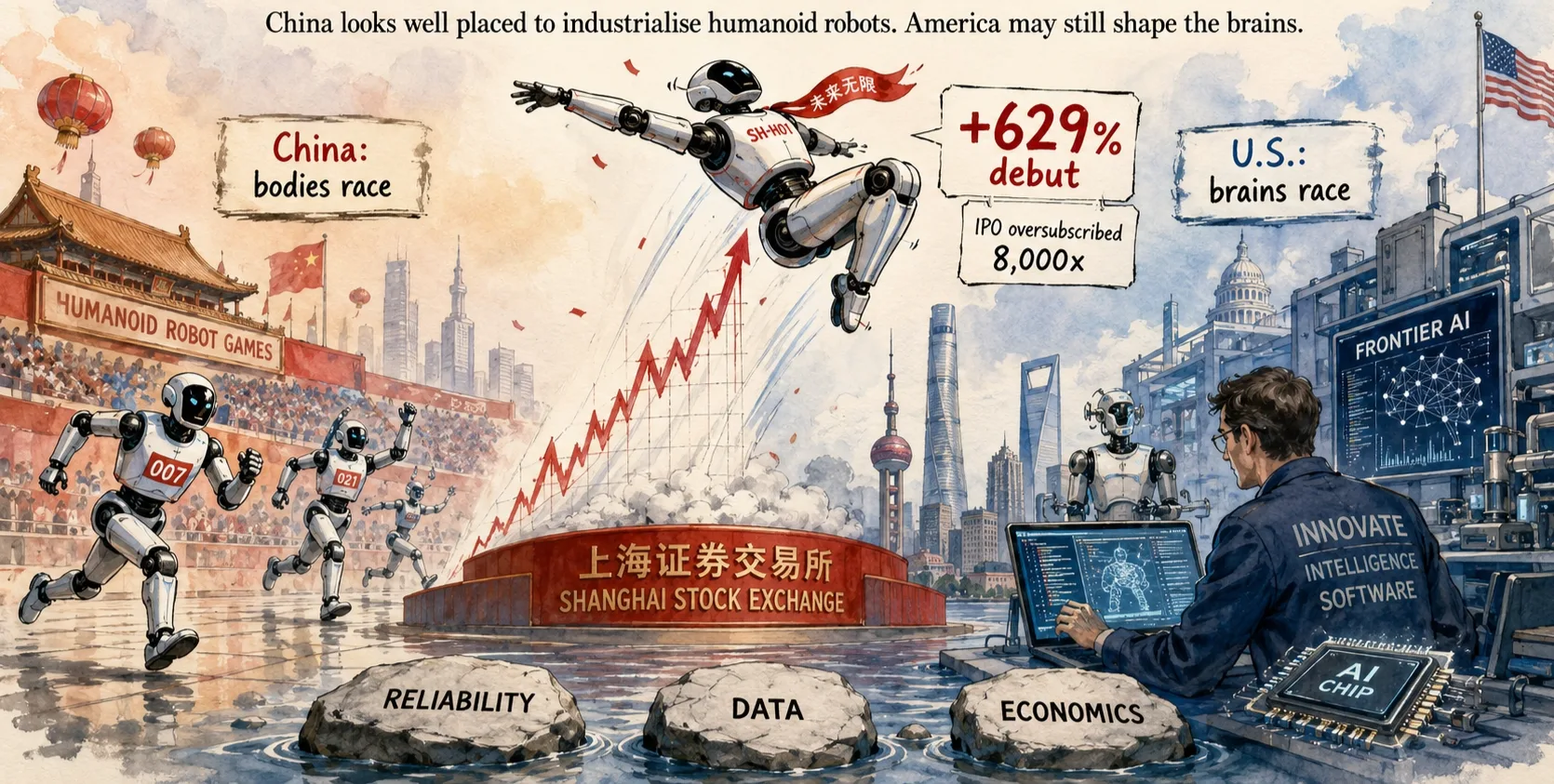
Unitree's 8,000×-oversubscribed Shanghai IPO surged 629% on debut. What the humanoid-robot frenzy says about China's bid to industrialise embodied AI.

A robot takes flight from the trading floor — the valuation left gravity behind at the bell.
Vol 1, Issue 07A robot takes flight from the trading floor — the valuation left gravity behind at the bell.
The Brief

Unitree, the Chinese humanoid robot maker known for backflips, dancing machines and now a robot called "Superman", raised RMB 6.1 billion in Shanghai in an IPO reportedly oversubscribed more than 8,000 times by retail investors. On debut, the stock surged as much as 629%.

There is a reason the enthusiasm is building now. Beijing hosted the second World Humanoid Robot Games, a showcase built around exactly the sort of spectacle that makes a young industry feel inevitable: robots running, dancing, competing and performing practical tasks.

China increasingly looks like the place trying to industrialise humanoid robots. The United States still has many of the ingredients that matter most in AI: frontier models, leading chips, top research and deep software capability. But China has been assembling a different advantage. It has manufacturing scale, a deep hardware supply chain, intense domestic competition and a political system willing to support sectors it sees as strategically important.

Building a convincing demo is one thing. Building thousands of units cheaply enough for commercial adoption is another. China has already shown in solar, batteries and electric vehicles that it can move from curiosity to cost advantage very quickly. The robot race may follow a similar path.

Humanoid robots still face three obvious problems.

First, reliability. A backflip in a controlled environment is impressive. Replacing a worker in a warehouse, factory, hospital or hotel is harder. Real work involves repetition, judgment, error handling and operating safely around humans.

Second, data. Robot brains need vast amounts of real-world experience, not just simulations. That is one reason embodied AI is attracting so much attention. The more robots move through factories, shops and homes, the more usable data they generate. Scale itself becomes an advantage.

Third, economics. The robot only becomes truly interesting when it is cheaper, more flexible or easier to deploy than the alternative. Until then, it remains a demo with a valuation attached.

The United States may still shape the "brains" of the category. China may be better positioned to win the "bodies" race, taking components, manufacturing know-how and falling costs and turning them into commercial deployment. If so, the eventual winners may not be whoever builds the most charismatic robot. They may be whoever most efficiently closes the gap between prototype and product.

Our brief

The robot IPO did not just show that investors love a story. It showed that humanoid robotics is starting to look investable enough for markets, governments and industry to organise around it. That does not mean adoption is imminent, it means the race is now real.

Macro

Factor / ThemeOur read
Global bondsthe long end pushes back
Our readLong-dated government yields rose sharply across the U.S., Europe and Japan. The U.S. 30-year Treasury touched 5.3%, its highest since 2007, despite softer recent inflation and employment data. Washington responded by expanding purchases of older long-dated Treasuries, briefly pulling yields lower before the move largely reversed. The message from markets is uncomfortable: central banks may control overnight rates, but fiscal credibility, supply and inflation increasingly determine the cost of long-term capital.
U.S.growth refuses to cooperate with the slowdown story
Our readFed minutes showed that several policymakers had favoured a July rate hike and many were prepared to tighten if inflation remained stubborn. Yet the data remain contradictory. July retail sales weakened, while August's flash services PMI jumped to 56.8, its strongest reading since December 2024, suggesting Q3 growth could accelerate materially from Q2's 1.5% annualised pace. The Fed is not choosing between growth and inflation yet. It is still getting both.
Chinafactories cannot do everything
Our readJuly industrial production slowed to 4.5%, retail sales grew just 0.6%, and fixed-asset investment contracted 6.7% over the first seven months. China's export and high-tech manufacturing machine remains formidable, but domestic demand continues to look weak. The question is increasingly whether Beijing can rebalance growth towards households without weakening the industrial model it has spent years strengthening.
Japanweak growth, higher rates
Our readJapan's economy grew only 1.1% annualised in Q2, below expectations, with consumption and capital spending both weak. Yet July core inflation accelerated to 1.8%, wholesale inflation is above 7%, and 10-year government bond yields reached a three-decade high. Japan spent years trying to escape deflation. It may now discover that normalising policy is considerably harder than creating inflation in the first place.
UKinflation up, economy still standing
Our readUK inflation rose to 2.9% in July, largely because of a 13% increase in regulated household energy tariffs. Yet services inflation eased and the economy continued to surprise positively: the August services PMI reached a six-month high of 52.8, while consumer confidence hit a two-year high. Britain is giving the Bank of England a familiar problem, more inflation than it wants and more resilience than would justify ignoring it.
Eurozonemanufacturing finally joins the recovery
Our readThe eurozone composite PMI rose to 52.1, with new orders growing at their fastest pace in more than three years and export orders increasing for the first time since Russia's 2022 invasion of Ukraine. Manufacturing reached a 54-month high and employment rose for the first time this year. Europe is still facing energy and inflation risks, but the recovery is becoming broader than services alone.

Public markets

Name / ThemeWhat happenedOur read
Walmartthe resilient consumer finally blinks
What happenedU.S. comparable sales grew 2.6%, the slowest pace in six years and below expectations of 3.8%. Walmart still raised full-year guidance, but shares fell more than 9.0%, wiping over $80bn from its market value.
Our readWalmart has been one of the cleanest expressions of consumer resilience because its value proposition normally benefits when households trade down. A miss here is therefore more informative than weakness at a discretionary retailer. Consumers are not stopping spending, but price sensitivity is becoming harder to ignore.
Targetexecution beats the macro
What happenedComparable sales increased 3.8%, ahead of expectations, digital sales grew 8.7%, and Target raised its annual sales forecast for the second time this year. Shares rose after the results. Profit was helped materially by tariff refunds, but traffic also improved.
Our readWalmart and Target reported into the same consumer environment and produced very different outcomes. That is a useful reminder that macro conditions explain only part of company performance. Merchandising, pricing and execution still matter.
Home Depot + Lowe'srepair, don't renovate
What happenedHome Depot's quarterly sales rose 5.7% and comparable sales increased 1.7%, while Lowe's beat profit expectations but cut its annual comparable-sales outlook. Both companies described resilient demand for smaller repairs alongside continued weakness in expensive renovation projects.
Our readThe U.S. housing freeze is changing what homeowners spend on rather than eliminating spending altogether. High mortgage rates discourage moving and major projects, but they also leave people maintaining homes they stay in for longer. Small-ticket repair is proving much more durable than big-ticket renovation.
AlibabaAI revenue arrives before AI profits
What happenedRevenue rose 9%, while cloud and AI-services revenue increased 45%. But quarterly net profit fell 75% as capex jumped 75% to RMB68bn. Alibaba has already spent roughly half of its planned RMB380bn AI investment and says current economics imply payback within three years.
Our readThis may be one of the most useful AI disclosures in the market. Alibaba is giving investors an explicit payback target rather than simply asking them to trust that spending will work. The next question is whether 45% growth can become cash flow before the infrastructure bill gets larger again.
Unitreegravity leaves the IPO market
What happenedChinese humanoid-robot maker Unitree surged as much as 629% on its Shanghai debut after an IPO that was reportedly more than 8,000 times oversubscribed by retail investors. The company has delivered around 18,000 bipedal humanoid robots.
Our readThe valuation is difficult to defend using conventional earnings, but the enthusiasm tells us something real. Chinese investors increasingly see humanoid robotics as an industrial category rather than a research experiment. The EV comparison is starting to become difficult to avoid.
Europethe earnings recovery broadens
What happenedForecast STOXX 600 Q2 earnings growth increased for the ninth consecutive week to 24.1%. Almost 60% of reporting companies beat expectations, and even excluding the energy sector, earnings are expected to rise 13.1%.
Our readEurope's earnings story is no longer only about oil companies benefiting from higher energy prices. Industrials and materials are joining the recovery. That matters because European equities remain easier to dismiss when the earnings growth is concentrated in one exceptional sector.

M&A

Name / ThemeWhat happenedOur read
Steadfastprivate capital spots another valuation gap
What happenedAustralia's Steadfast agreed to a A$7.7bn ($5.5bn) acquisition by a consortium backed by KKR, Amwins and Dragoneer. The A$6-per-share offer represents a roughly 52% premium to the company's pre-approach price.
Our readAustralia is developing the same public-to-private dynamic seen in the UK: quality mid-cap businesses trade at valuations global private capital is willing to challenge. A 52% premium is not just a control premium. It is an argument about what the public market was missing.
WSPArcadis / hostile engineering
What happenedCanada's WSP said it would continue pursuing Dutch engineering consultancy Arcadis despite two rejected approaches. Its latest proposal values Arcadis at roughly €5.4bn including debt, while Arcadis argues the offer materially undervalues the business.
Our readEngineering and consultancy platforms are becoming more strategic as infrastructure, energy transition and climate adaptation spending rise. But Arcadis also shows the limits of consolidation: a strategically logical deal is not necessarily an executable one when shareholders, employees and Dutch takeover defences all have a vote.
Pinewoodanother UK listing heads private
What happenedUK automotive software provider Pinewood Technologies agreed to a £545mn takeover by U.S. private-equity firm Ridgeview, following an earlier approach from Apax that fell away.
Our readAnother listed UK technology business is leaving public markets. The pattern is increasingly difficult to ignore: overseas private capital continues to find value in UK-listed assets that domestic public markets struggle to price enthusiastically.
Mitsubishi ElectricPCI Energy Solutions
What happenedMitsubishi Electric agreed to acquire U.S. energy-management software company PCI Energy Solutions for $1.4bn, its largest acquisition to date. PCI provides software for power trading, generation scheduling, transmission operations and demand forecasting.
Our readEnergy infrastructure is becoming increasingly software-defined. Mitsubishi is not simply buying a SaaS company; it is buying the optimisation layer sitting above physical power assets. As grids become more complex, that layer can become as strategically important as the equipment itself.
Union PacificNorfolk Southern / the $85bn rail test restarts
What happenedThe U.S. Surface Transportation Board resumed its review of Union Pacific's proposed $85bn merger with Norfolk Southern, while stressing that restarting the process should not be read as approval.
Our readA coast-to-coast rail combination would create extraordinary network benefits, but also extraordinary regulatory questions. The deal is a useful test of whether Washington's broader deregulatory instinct extends to sectors where physical-network concentration is impossible to ignore.
ParamountWarner Bros / time itself becomes expensive
What happenedParamount asked a court to require states challenging its $110bn acquisition of Warner Bros Discovery to post a $1.9bn bond. Paramount faces a $7mn-per-day ticking fee if the transaction misses its September deadline.
Our readDeal risk is usually discussed through break fees and financing conditions. Here, time itself has become an enormous liability. The longer the legal process runs, the economics change even if the strategic rationale does not. At this scale, regulatory delay is effectively another form of purchase price.

Staying Diligent

Things we are watching this week: 24–30 August:

Event / ThemeWhy we care
Nvidiathe AI demand test
Why we careNvidia reports on Wednesday 26 August. After the recent wobble in semiconductor stocks and the jump in long-term bond yields, another earnings beat may not be enough. We will be watching hyperscaler demand, margins and whether customers are still expanding AI spending fast enough to justify the extraordinary amount of capital now being committed to data centres. Nvidia recently helped establish financing platforms targeting more than $500bn of third-party AI infrastructure capital. The bigger question is whether demand can continue growing quickly enough to earn a return on it.
U.S. PCE + GDPthe numbers before Wyoming
Why we careWednesday also brings July PCE inflation, the Fed's preferred measure, alongside the second estimate of Q2 GDP. The first GDP estimate showed growth slowing to 1.5% annualised, even as underlying private demand remained considerably stronger. Cooler inflation plus resilient growth is the benign outcome; another inflation surprise would make the Fed's job much harder.
Jackson HoleWarsh has to say something eventually
Why we careThe annual Jackson Hole symposium runs 27–29 August, with Fed Chair Kevin Warsh making his first appearance since taking office. Markets are still trying to understand a Fed that has deliberately stepped away from traditional forward guidance. With long-term Treasury yields elevated, investors want more than philosophy. They want to know what would actually trigger the next rate move.
Australia + South KoreaAsia's inflation problem
Why we careAustralia publishes July CPI on Wednesday, while South Korea's central bank meets on Thursday. The two economies illustrate the same uncomfortable problem from different directions: inflation remains sticky while parts of domestic demand are beginning to soften. Korea also has the complication of an AI-driven semiconductor boom supporting growth and the currency.
Chinaare strong factories actually making money?
Why we careChina's July industrial-profit figures are due on Thursday. Manufacturing and exports remain important supports for the economy even as domestic demand weakens. The profit data should help show whether China's high-tech and export strength is still translating into healthy corporate economics rather than simply more production.
UK data centreswhen AI becomes GDP
Why we careOn Monday, the ONS publishes work on data centres and the UK National Accounts. It sounds technical, but the underlying question matters. As billions are spent on compute, power and data centres, official statistics need to distinguish between an AI narrative and actual capital formation. If AI is becoming physical infrastructure, GDP measurement needs to catch up.
Icelanddoes geopolitics make Europe more attractive?
Why we careIceland votes on 29 August on whether to reopen EU accession talks, more than a decade after negotiations were abandoned. It is a small economy, but the referendum touches much larger questions around fisheries, the euro, Arctic security and Europe's changing geopolitical position. Watch whether uncertainty outside the bloc is making membership look more attractive than it did before.

Unhedged Commentary

AI is making knowledge cheaper and verification more expensive.
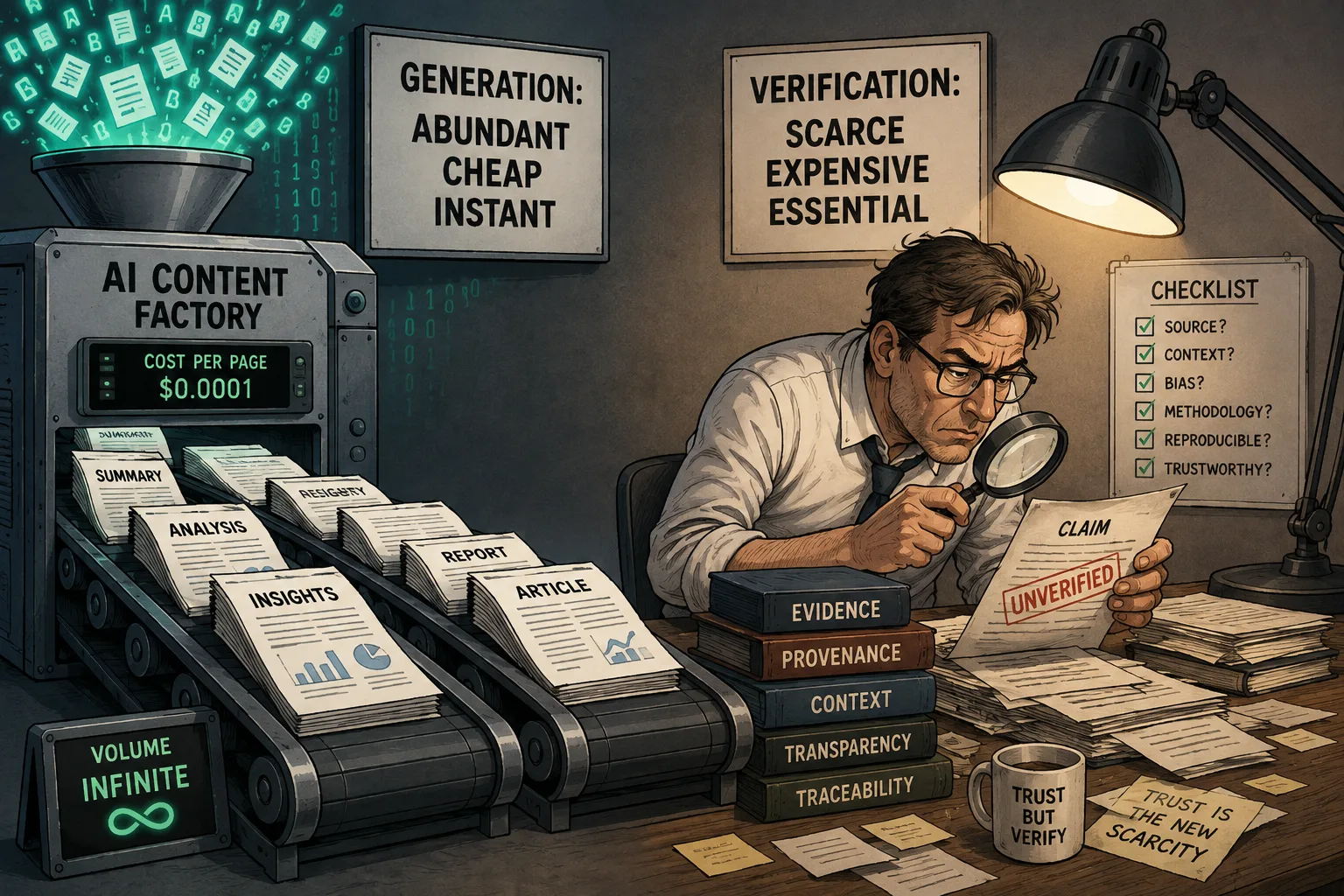
Answers pour out by the pallet; the scales that weigh them are where the queue forms.

AI is doing something extraordinary to knowledge work. It is making the production of plausible text, summaries, explanations and even research-looking output dramatically cheaper. The cost of producing something that sounds informed is collapsing. More people can draft faster, analyse more material and get to a first answer in seconds rather than hours. The productivity gain is real.

The problem is that the cost of verification is not falling at the same speed. This week, Nature reported that around 90% of biomedical papers published in December 2025 and indexed in PubMed showed signs of AI-assisted writing. Separately, a California appeals court sanctioned a lawyer after AI-generated fake citations ended up in a legal filing. These are very different settings, but they point to the same underlying issue. Knowledge is becoming abundant, trust is not.

That distinction matters because most professional work does not fail at the point of drafting. It fails at the point where someone assumes the draft is true. In a world where machines can instantly produce convincing prose, the scarce asset is no longer expression, it is provenance.

When text is cheap, bad text multiplies. When summarising becomes trivial, unsupported summarising becomes common. When everyone can generate something that looks polished, polish stops being a signal of quality.

In many high-trust settings, the answer itself is not the final product. The final product is a defensible answer. That requires citations, context, traceability and the ability to inspect what sits underneath the surface. In other words, the premium is moving from content to confidence.

Media businesses will need to show why their information is reliable, not just fast. Scientific publishing will need stronger norms around disclosure and attribution. Legal and financial professionals will need workflows built around checking, not merely generating. And companies building AI tools will increasingly be judged not only on what they can produce, but on how well they can ground, track and audit what they produce.

This is also where a quieter opportunity sits. In a world of infinite answers, tools that preserve evidence start to matter much more. Not because they slow work down, but because they make fast work usable. The more AI compresses the cost of saying something, the more valuable it becomes to know exactly where that something came from.

Our view

AI is making knowledge cheaper, but it is simultaneously making verification more valuable. The winners will not simply be the platforms that generate the most text. They will be the systems that make text trustworthy enough to use when the consequences matter.

The future of knowledge work may still be automated, but it will have to be auditable.

In Other News
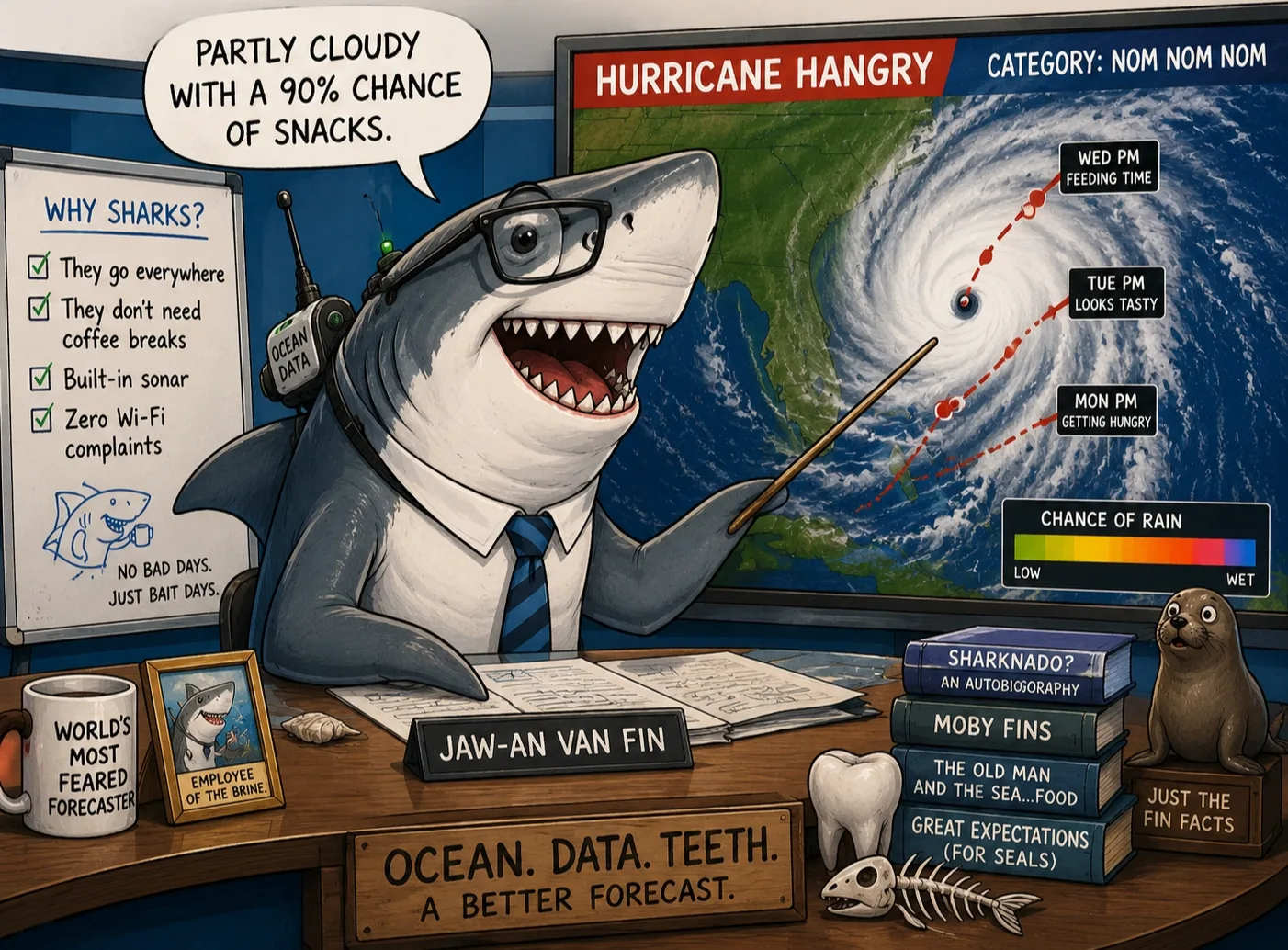
The ocean's oldest network, newly instrumented.

Your meteorologist has teeth.

The latest tool in hurricane forecasting is not a satellite, a drone or a new buoy. It is a shark.

Scientists in the United States are attaching small sensors to sharks to collect real-time ocean data, particularly temperature and depth information from the upper ocean layer that helps fuel hurricanes. In effect, the sharks become moving data platforms, swimming through areas where better information can improve forecasting.

The story is unusual enough to be memorable, but the business lesson is surprisingly familiar. When organisations think about innovation, they often start by imagining new infrastructure. But sometimes the most useful asset already exists.

The sharks are already swimming. The challenge is not creating the network, it is finding a way to make the network useful. Many businesses overlook opportunities because they focus on building from scratch rather than reusing what is already there. A company may already have a customer base that can double as a distribution channel, a product that can generate valuable data, a service team that can become a sales engine or a piece of infrastructure that can support an adjacent business line.

The best innovations are often the ones that fit naturally into the real world rather than requiring the world to rearrange itself around them. A shark does not need to be persuaded to swim. A customer does not need to be taught a new habit if your product improves the one they already have. A team adopts new tools more readily when those tools sit inside existing workflows.

The lesson: before investing heavily in building a new network, ask whether one already exists, quietly moving through the world, waiting to become useful. Sometimes the smartest sensor is the one with fins.

The Thinking Corner

When one country leads in software and another in manufacturing, which advantage ultimately matters more in determining who captures the economic value from the next technology cycle?

From The Felix View

Latest from the team

Market commentary and field notes from the team, on The Felix View.

Get Noise to Signal in your inbox.

One email a week · every figure sourced · unsubscribe any time

The securities referenced do not represent buy or sell recommendations. These notes describe corporate events and possible catalysts only. Figures are sourced from public filings, company presentations and market data; every claim links to its source. Prepared for institutional research use.

Vol. 1
2026-08-25 · UTC−08:00