
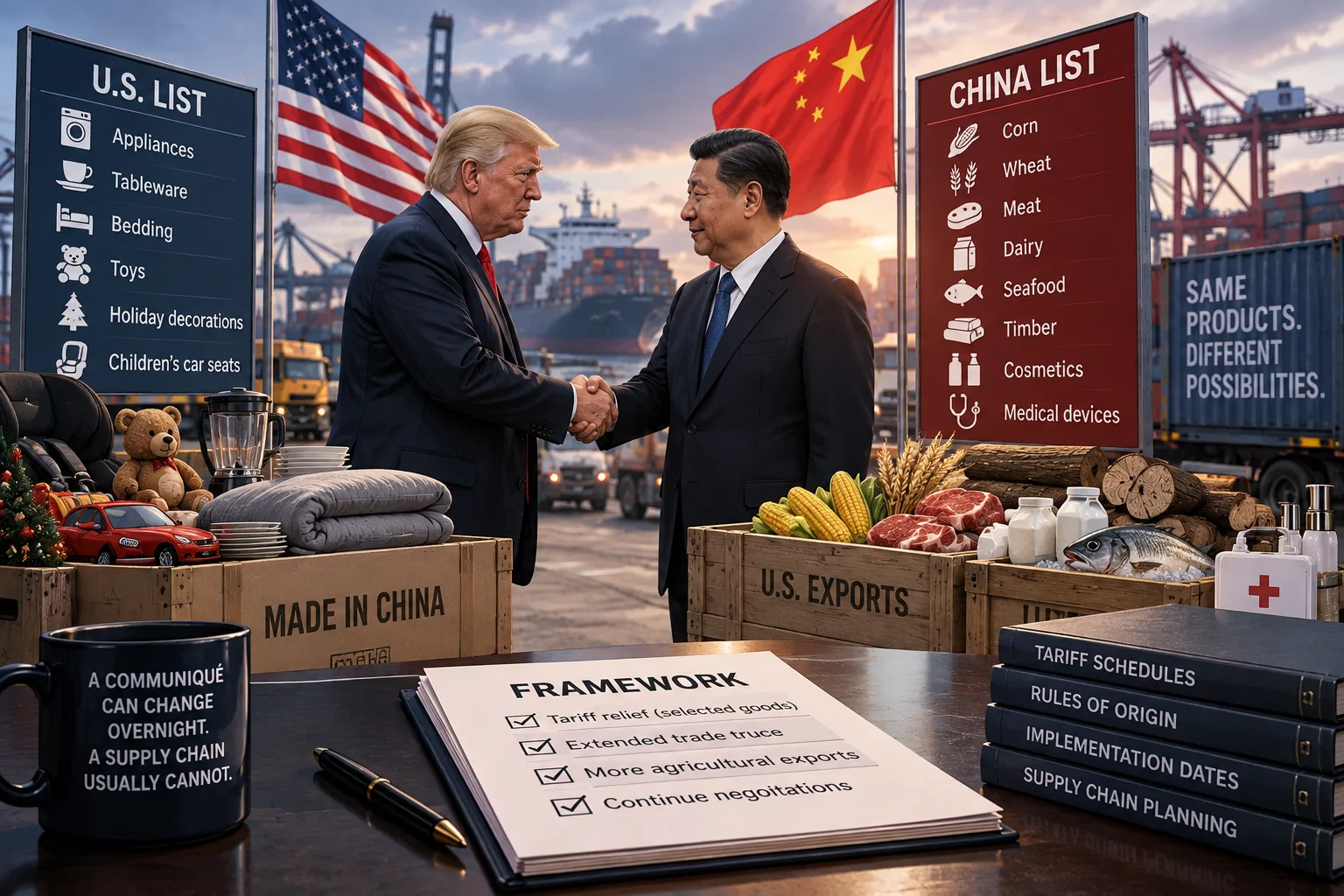
Donald Trump and Xi Jinping spent last week talking about the world's most consequential trading relationship. A bilateral trade board has recommended around $30bn of non-sensitive goods on each side for possible more favourable tariff treatment. China's list covers U.S. products including corn, wheat, meat, dairy, seafood, timber, cosmetics and medical devices. The U.S. list includes Chinese appliances, tableware, bedding, toys, holiday decorations and children's car seats. Together, roughly $60bn of bilateral trade is under consideration; the tariff changes have not taken effect.
There were other commitments. China agreed to import 10mn tonnes of U.S. coal in both 2027 and 2028. The trade board, established earlier this year, will continue work on the product lists. The two countries also extended their existing trade truce by two months, to 10 January.
There is a difference between a diplomatic agreement and something a procurement department can put into a spreadsheet. A company deciding whether to change supplier still needs to know the exact tariff rate, when it takes effect, which product code qualifies, what rules of origin apply and how long the arrangement is likely to survive.
That distinction becomes particularly important when investment horizons are long. A retailer deciding whether to import another shipment of toasters can react quickly to a tariff reduction. A manufacturer deciding where to build its next factory cannot.
Factories, warehouses and supplier relationships are built for years. A trade truce that expires in January is useful, but it does not remove the possibility that the economics change again before the asset has even opened.
The products proposed for relief are relatively ordinary. Coffee makers. Toys. Corn. Timber. Bedding. Trade disputes are often discussed through semiconductors, national security and strategic technologies. Yet tariffs ultimately reach the mundane products moving through ports every day, and that is where changes in policy start appearing in working capital, sourcing decisions and consumer prices.
The summit therefore matters less as a reset of the U.S.–China relationship than as another adjustment to the economics sitting underneath it. Both governments have kept negotiations open and provided some additional near-term visibility. They have not removed the reasons companies spent the past several years diversifying supply chains.
The summit reduced some immediate friction, but businesses still need tariff schedules, effective dates and durability before they can treat diplomacy as economics. A communiqué can change overnight. A supply chain usually cannot.
Macro
Public Markets
M&A
Staying Diligent
Things we are watching: 28 September–2 October
Calendar prepared 28 September; developments on 29 September updated below.
The Unhedged View
When carbon becomes the crop.
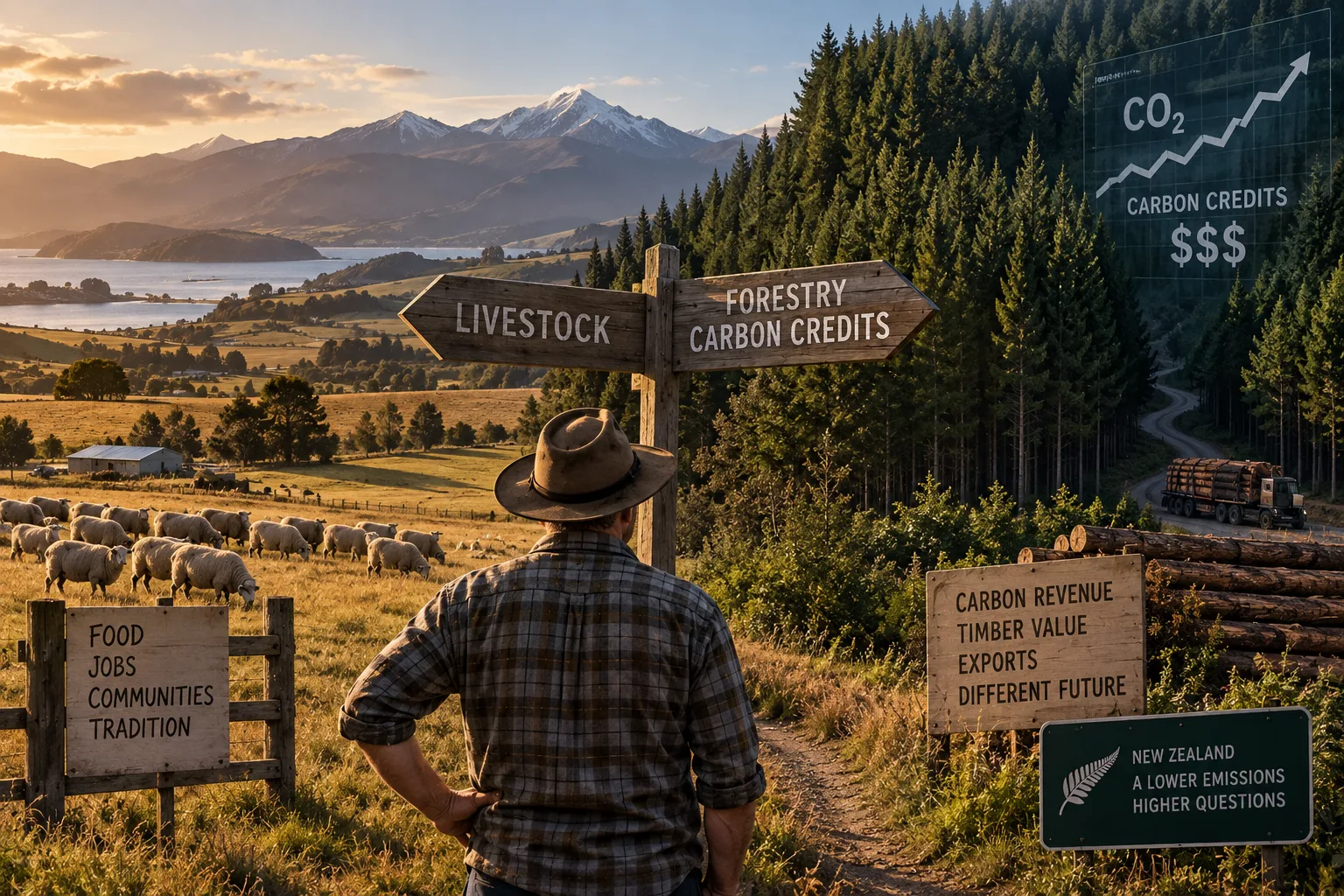
Something unusual is happening to farmland in New Zealand. The most valuable thing growing on parts of it may no longer be food.
Under New Zealand's emissions trading scheme, qualifying forest owners receive carbon credits as trees absorb CO₂. Those credits can be sold to companies that need to offset emissions, creating an income stream before the timber itself is harvested. That changes the economics of the land.
Since 2017, around 3,300 square kilometres of sheep and beef farmland have been sold for conversion to forestry, according to Beef + Lamb New Zealand data. The area is sufficient to support more than two million sheep, equivalent to roughly 9% of the national flock. Grazing-land prices rose 9.7% as forestry investors competed for suitable properties.
The important point is not that forestry is somehow an economically artificial use of the land. Trees store carbon. Timber has value. New Zealand's Climate Change Commission expects ETS forests to provide around a quarter of the emissions reductions required for the country's 2026–30 target and nearly half for 2031–35. The government describes forestry as a cost-effective component of its emissions strategy.
But once carbon storage is given a market price, it becomes another product the land can produce. And land tends to move towards the activity offering the highest risk-adjusted return.
If forestry can pay more than sheep or cattle, agricultural land values change. Fewer animals require fewer shearers, transporters and agricultural suppliers. Forestry creates its own jobs and export revenue, but with a different labour footprint and economic geography. Forestry representatives dispute the claim that the sector is hollowing out rural areas and point to around NZ$6.5bn of annual forestry exports; red-meat exports are roughly NZ$12.0bn.
For investors, that creates another layer of underwriting. Buying land for carbon-credit income is not simply a forestry investment. It is partly an investment in the continuing design of the carbon market: eligibility rules, credit prices, permanence requirements and restrictions on where conversion is allowed. The asset can be perfectly real while part of its value remains policy-dependent.
Once carbon becomes a revenue line, it competes with everything else the asset could produce. That does not make carbon markets ineffective. It means investors need to underwrite both sides of the price signal: what the new incentive creates, and what it causes the land to stop doing.
In Other News

Same tennis. Different incentives.
At first glance, the Laver Cup is fairly normal tennis. But somebody changed the spreadsheet.
At the tournament held in London this weekend, a match won on Friday was worth one point. The exact same achievement on Saturday was worth two. On Sunday, it was worth three. The first team to 13 won. Team Europe ultimately beat Team World 13–5, with Alexander Zverev securing the decisive victory on Sunday.
The scoring system is interesting because nothing about the underlying unit of activity changes. A win is still a win. Its value changes depending on when it happens. That alters behaviour around it.
Captains have to think about which players to use, when to deploy them and how much strategic value sits in later sessions. Friday matters, but it cannot settle the tournament. Sunday is mechanically more consequential because the same win carries three times as many points.
Businesses do this constantly, although usually with less attractive backhands. Sales commissions increase above a quota. Loyalty points become more valuable at certain thresholds. Bonuses change when targets are crossed. Discounts expire at the end of the month. The underlying activity remains the same; the payoff around it changes.
That is why incentive design can matter as much as product design. If you want different behaviour, rebuilding the entire product is not always the first answer. Sometimes the rules around the product are doing more work than the product itself.
The lesson: changing what an action is worth can change when, how and how hard people pursue it. Same tennis. Different incentives.
The Thinking Corner
When a policy, price or scoring system changes behaviour, how do we distinguish genuine underlying demand from behaviour created by the rules themselves?
Latest from the team
Market commentary and field notes from the team, on The Felix View.