
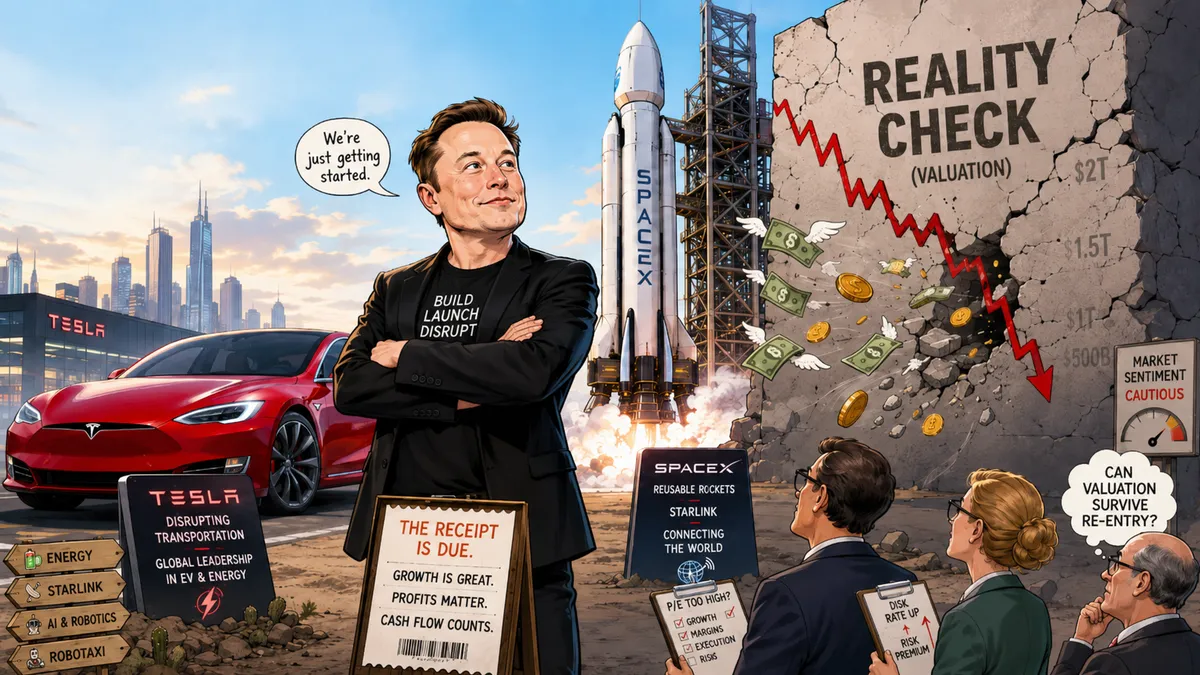
The market gave Elon Musk a rare reminder last week: even gravity eventually applies to companies building rockets. Last week Tesla fell 17.8%, SpaceX fell 7.2%, and the broader tech complex lost some of the effortless confidence that has carried it for much of the year. The issue is not that investors suddenly think Tesla, SpaceX, AI, autonomy or space are irrelevant. Quite the opposite. These are still some of the most ambitious companies and markets in the world.
The issue is price. Musk remains one of the great company builders of modern markets. Tesla changed the automotive industry. SpaceX changed the economics of launch, satellite connectivity and private space infrastructure. Very few people can turn impossible-sounding ideas into industrial reality, and even fewer can do it more than once.
But markets do not only price ambition. Eventually, they price proof. Tesla's results reminded investors that the company still needs to show the bridge between today's car business and tomorrow's autonomy, robotics and AI opportunity. The market may believe in the destination, but it is becoming less relaxed about the cost, timing and execution risk of getting there.
SpaceX adds a different version of the same question. The company remains strategically extraordinary, but the stock has moved from scarcity-driven excitement to liquidity-driven scrutiny. A post-IPO sell-off is one thing. A sell-off before major lock-up expiries is another. Investors are now asking what happens when more holders are allowed to sell, and whether the valuation can absorb that supply without the benefit of unlimited hype.
There is a slightly absurd version of this story where hundreds of billions of dollars can disappear from quoted market value and the companies involved are still among the most important in the world. That is the Elon premium and the Elon problem in the same sentence. The companies can be exceptional, and the stocks can still have been too expensive.
Our read: this is not the end of the Musk industrial empire. The market is still willing to fund big visions. But it now wants more than theatre, timelines and future optionality. It wants margins, cash flow, credible capex returns and evidence that the next chapter is not just larger, but economically better.
The rocket may still fly. The question is whether the valuation can survive re-entry.
Macro
Public markets
M&A
Staying Diligent
Things we are watching this week: 27-31 July
Unhedged Commentary
France and the maths of credibility
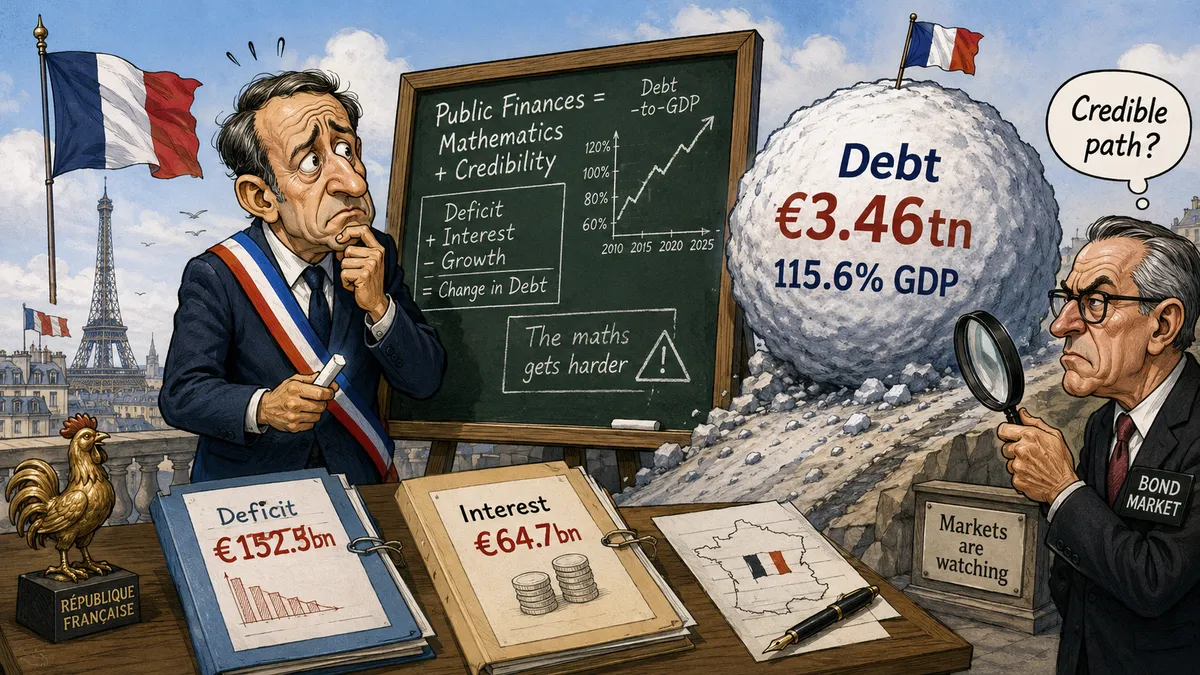
The broader market usually starts caring about sovereign debt too late. For years, France's public finances have looked uncomfortable but manageable. High spending, modest growth, recurring deficits and a rising debt ratio were not new. Markets knew the story. They priced it, complained about it, then moved on, because well, it's France, and they're solid enough.
The problem is that the maths is changing. France ended 2025 with a general public deficit of €152.5bn, equal to 5.1% of GDP, and public debt of €3.46tn, or 115.6% of GDP. Interest expenditure rose to €64.7bn, up 11.2% year-on-year, and now stands at roughly 2.2% of GDP.
France is not running out of buyers tomorrow. The average maturity of its debt means higher rates feed through gradually rather than all at once. But gradually is not the same as harmless. The issue is the direction of travel. When debt is high, growth is weak and interest costs are rising, the bond market starts asking a different question. Not "can France pay next month?" but "what is the credible path from here?"
That question is becoming harder to answer. Growth is low, the deficit remains well above 3% and debt is forecast to move above 120% of GDP. Ageing, defence, climate investment and energy security all require money. Politics makes hard trade-offs difficult. And markets are less patient when higher yields offer them alternatives.
This is not a Greece-style story. France is larger, richer, more diversified and central to the euro project. It also benefits from a deeper bond market and the broader architecture of the eurozone, not to mention a rather patriotic community of banks that make sure its standing in markets is sound. Still, even the French are not immune from bond worries. In some ways, its size is exactly why it matters.
A French fiscal scare would not stay French for long. It would move through OAT-Bund spreads, bank balance sheets, insurers, utilities, infrastructure assets, corporate funding costs and the wider credibility of the euro area. France is too big to be treated as a local problem. Just like its banking community loves France and helps it, so does the sovereign.
What should France do? Not panic, and not pretend. The answer is not blunt austerity for its own sake (especially because in France, the mere mention of the word austerity would cause more in losses due to protests and riots than the state would save). Cutting productive investment would be a mistake. So would relying mainly on temporary tax rises in a country where the tax burden is already high. The better answer is harder: a credible multi-year fiscal plan, slower current spending growth, reform of ageing-related expenditure, fewer inefficient tax breaks, protection of investment that improves productivity, and structural reforms that make it easier for companies to grow. It's the boring, sensible answer, but also the one that has legs.
The bond market does not need France to become Germany overnight. It needs evidence that the trajectory has changed.
Our read: France is not on the edge of a euro crisis today. But it is on a collision course with the question that eventually catches every high-debt economy: who is paying, when, and at what cost. That question is boring only until markets decide it is not.
In Other News

The quiet rebellion of enough
There is a growing corner of the internet built around four letters: FIRE. Financial Independence, Retire Early.
The idea is simple enough. Save aggressively. Invest consistently. Avoid lifestyle inflation. Build enough financial independence that work becomes a choice rather than a necessity. For some, the dream is to retire in their 30s or 40s. For others, it is less dramatic: work less, choose better, own their time, and stop running a life that only makes sense if income keeps rising forever.
It is easy to mock. Some of it can sound extreme: spreadsheets for happiness, lentils as a lifestyle strategy, and a suspicious amount of content about compound interest. But underneath the optimisation culture is a serious question: how much is actually enough?
That question matters because modern life is very good at expanding the definition of need. Bigger house. Better car. More holidays. Better restaurants. More subscriptions. More status. More everything. The problem is that "more" often comes with a hidden invoice: more stress, more fixed costs, more dependence on income, and less room to make choices.
FIRE is not really about doing nothing. At its best, it is about reducing the number of things that own you. Less can be more because fewer obligations can create more freedom. A lower cost base gives you more options. A simpler life gives you more resilience. A smaller ego makes it easier to walk away from things that look impressive but feel empty.
There is a business lesson here too. Companies make the same mistake individuals do. They confuse growth with progress. They add products, markets, headcount, software, offices and complexity, then wonder why everything feels heavier. Revenue may be higher, but so is the break-even point. The organisation becomes more successful on paper and less free in reality.
The best operators understand the power of enough. Enough cost discipline to survive a downturn. Enough focus to avoid chasing every opportunity. Enough margin of safety to make decisions calmly. Enough clarity to say no.
That does not mean ambition is bad. FIRE without purpose can become another optimisation trap. Businesses that only cut and never build become small for the wrong reasons. The point is not to worship minimalism. The point is to understand the trade-off.
More is not always more. Sometimes more is just a longer chain. The real lesson from FIRE is not that everyone should retire at 40. It is that freedom has a balance sheet. The fewer things that depend on everything going perfectly, the more choices you have when life does not.
Latest from the team
Market commentary and field notes from the team, on The Felix View.