Noise to Signal·Vol 1·Issue 09·Week of Sep 7, 2026

Good jobs became bad news again.

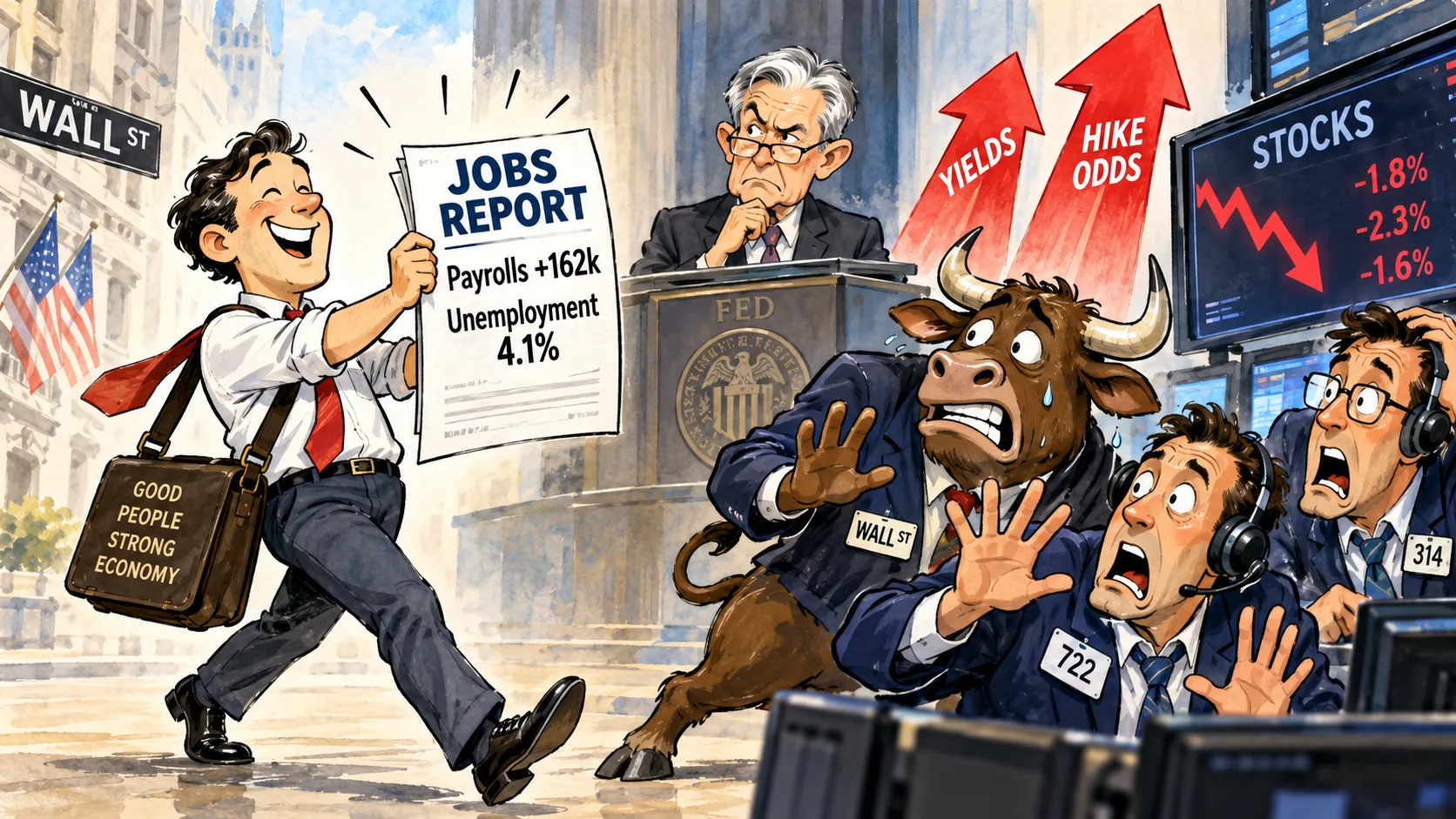
August payrolls beat forecasts nearly threefold, yet markets fell as traders priced in a higher chance of a September Fed hike — why good economic news is becoming bad market news.

Treasury yields climbed on the same report that beat every payrolls forecast — good news, priced as bad.
Vol 1, Issue 09Treasury yields climbed on the same report that beat every payrolls forecast — good news, priced as bad.
The Brief

For most of the summer, investors worried that the U.S. labour market was weakening too quickly. Then August payrolls arrived. The economy added 162,000 jobs, almost three times the 56,000 economists expected, while unemployment remained at 4.1%. The labour force also expanded strongly. In almost any normal environment, that would be good news.

But markets did not celebrate. Treasury yields rose, stocks slipped and traders increased the probability of a September Fed hike to roughly 60%. The reason is simple: the market does not currently need more growth. It needs evidence that inflation can return to target without another round of tightening.

August services activity strengthened, new orders reached their highest level in three and a half years, and input-price pressures remained elevated. Manufacturing was weaker, but the broader economy continues to look considerably more resilient than the July payroll figures suggested.

This creates an awkward inversion. Weak employment data increase the chance of lower rates, which can support asset prices. Strong employment reduces recession risk, but also gives the Fed more freedom to tighten. Good economic news becomes bad market news.

That does not mean investors should root for unemployment. It means valuations have become unusually sensitive to the price of money. When long-duration assets already assume years of future growth, a small change in discount rates can matter more than a healthy employment report.

If next week's CPI confirms that price pressures are easing, strong employment may look like the soft landing everyone wanted. If inflation remains sticky, August's jobs report gives the Fed considerably more room to act.

Our brief

Investors spent months asking whether the U.S. economy was slowing too quickly. It may turn out the more uncomfortable question is whether it has slowed enough.

Macro

Factor / ThemeOur read
U.S. jobsresilience returns
Our readAugust payrolls rose 162,000 versus 56,000 expected, with unemployment unchanged at 4.1%. Markets responded by increasing September hike expectations. July's weakness now looks much less like the start of a sharp employment downturn.
Global bondsthe price of capital resets
Our readGovernment borrowing costs rose sharply across developed markets, with long yields around multi-decade highs in several countries. Higher oil prices and fiscal deficits matter, but extraordinary private-sector demand for capital from the AI buildout may also be lifting equilibrium rates.
Eurozonemore growth, more inflation
Our readAugust inflation moved back above 3%, strengthening the case for another ECB hike, while manufacturing PMI reached 52.7, its strongest level since May 2022. Europe finally has a broader industrial recovery, just as monetary policy is becoming less supportive.
UKresilience has a price
Our readUK services PMI increased to 52.5, the strongest since April, as business and consumer spending improved. But firms also reported stronger cost pressures, giving the Bank of England another version of the same problem: growth is holding up while inflation risks refuse to disappear.
AsiaAI keeps the factories running
Our readChina, Japan and South Korea all reported manufacturing expansion in private August surveys, driven partly by demand for chips, computers and AI infrastructure. China's private PMI rose to 51.5, Japan's to 54.9, while South Korea expanded for a ninth consecutive month.
Indiainvestment finally joins consumption
Our readIndia's economy expanded 7.8% year-on-year in Q2, comfortably ahead of expectations, helped by stronger manufacturing and investment. More importantly, private-sector investment is showing signs of reviving after years in which government spending carried much of the burden.

Public markets

Name / ThemeWhat happenedOur read
DellAI becomes a server business
What happenedRevenue rose 58% to a record $47bn, while Dell increased its annual revenue forecast by $25bn. It has booked more than $130bn of AI-server orders over the past year. Shares rose 7% after hours.
Our readThe AI trade is broadening from chips into the companies that physically assemble, integrate and deploy the infrastructure.
Broadcomcustom silicon gets bigger
What happenedBroadcom increased its FY2027 AI-chip revenue forecast to roughly $115bn and expects that figure to double to around $230bn in FY2028. Q3 AI-chip revenue more than tripled.
Our readNvidia remains dominant, but Big Tech increasingly wants custom silicon. The AI hardware market may be enormous enough for several winners.
Snowflakesoftware finally gets its AI proof
What happenedSnowflake raised its product-revenue guidance and shares surged more than 20%. Management said AI accounted for roughly half of the recent acceleration in growth.
Our readAI software has spent several quarters promising monetisation. Snowflake is beginning to show it in consumption and revenue rather than demos.
Sheinpublic markets reset the price
What happenedShein debuted in Hong Kong at a valuation of around $26.3bn, versus almost $100bn at its private-market peak. Shares fell as much as 10% before ending broadly flat.
Our readPrivate markets can postpone price discovery. They cannot repeal it. Tariffs, weaker growth and regulatory risks eventually reached the valuation.
Deutsche Telekomthe activist votes for cash
What happenedDeutsche Telekom shares rose after Elliott built a stake and urged the company to abandon a potential T-Mobile merger in favour of larger buybacks and other value-return measures.
Our readInvestors are again asking a basic capital-allocation question: if management cannot demonstrate superior returns from a deal, why not return the money?
Foxconnthe physical AI economy
What happenedFoxconn reported record August revenue of T$921.8bn, up almost 52% year-on-year, and said Q3 should outperform expectations because of AI demand.
Our readAI demand is now visible across the manufacturing chain, not just at Nvidia and the hyperscalers. Taiwan remains one of the cleanest places to see the physical buildout.

M&A

Name / ThemeWhat happenedOur read
NvidiaHugging Face
What happenedNvidia agreed to acquire open-source AI platform Hugging Face for $12.9bn.
Our readNvidia is moving further up the software stack. Owning the chips is powerful; influencing where developers find and deploy models could make the ecosystem even stickier.
FlexEPC Power
What happenedFlex agreed to acquire data-centre power-conversion specialist EPC Power for $4.4bn.
Our readAI's bottlenecks are increasingly power and electrical infrastructure rather than processors alone. M&A capital is following the constraint.
KKRA1 Garage Door Service
What happenedKKR agreed to buy residential repair platform A1 Garage Door Service for around $2bn.
Our readNot every large PE deal needs AI. Fragmented, recurring local services with pricing power remain exactly the sort of boring businesses private capital likes to scale.
KeppelTokyo data centres
What happenedKeppel DC REIT and Keppel agreed to acquire interests in two Tokyo data centres for approximately $1.2bn.
Our readThe AI infrastructure trade is globalising. Japan offers scarce data-centre capacity in a market with rising cloud and compute demand.
NovartisAlteogen
What happenedNovartis agreed a deal worth up to $3.2bn for South Korea's Alteogen drug-delivery technology, which can convert intravenous medicines into injections.
Our readSometimes the innovation is not the drug but the delivery. Improving convenience can materially change the economics of an already successful therapy.
PlusAISPAC
What happenedAutonomous-trucking software company PlusAI agreed to go public through an $800mn SPAC transaction.
Our readSPACs have not disappeared; they have become more selective. Capital remains available where investors can see a credible path from autonomy demos to commercial deployment.

Staying Diligent

Things we are watching this week: 7–11 September:

Event / ThemeWhy we care
U.S. CPI + PPIthe Fed's deciding evidence
Why we careAugust PPI arrives 10 September, followed by CPI on 11 September. After the strong payroll report, inflation is likely to determine whether the Fed hikes on 15–16 September.
ECBanother hike, then what?
Why we careThe ECB meets on 10 September with markets almost fully pricing another 25bp increase after eurozone inflation rose above 3%. The more important signal will be whether policymakers view this as the end of the cycle or leave December open.
China CPI + PPIdemand versus factory strength
Why we careChina publishes August consumer and producer prices on 9 September. Manufacturing surveys improved, but weak domestic demand remains the missing piece. Inflation data will show whether stronger factories are finally translating into pricing power.
Applethe first Ternus launch
Why we careApple unveils its next iPhone generation on 9 September, its first major product event under new CEO John Ternus. A possible foldable device would be particularly important for pricing, margins and Apple's position in China.
UK GDPcan resilience continue?
Why we careJuly monthly GDP is released on 11 September. Recent PMIs suggest momentum improved over the summer, but households and businesses continue to face higher energy and borrowing costs.
JapanGDP and the September hike case
Why we careRevised Q2 GDP arrives early in the week after stronger corporate-capex data suggested the original growth estimate may be upgraded. With the Bank of Japan debating another hike later this month, stronger domestic demand would make the decision easier.

Unhedged Commentary

AI is raising interest rates before it lowers costs.
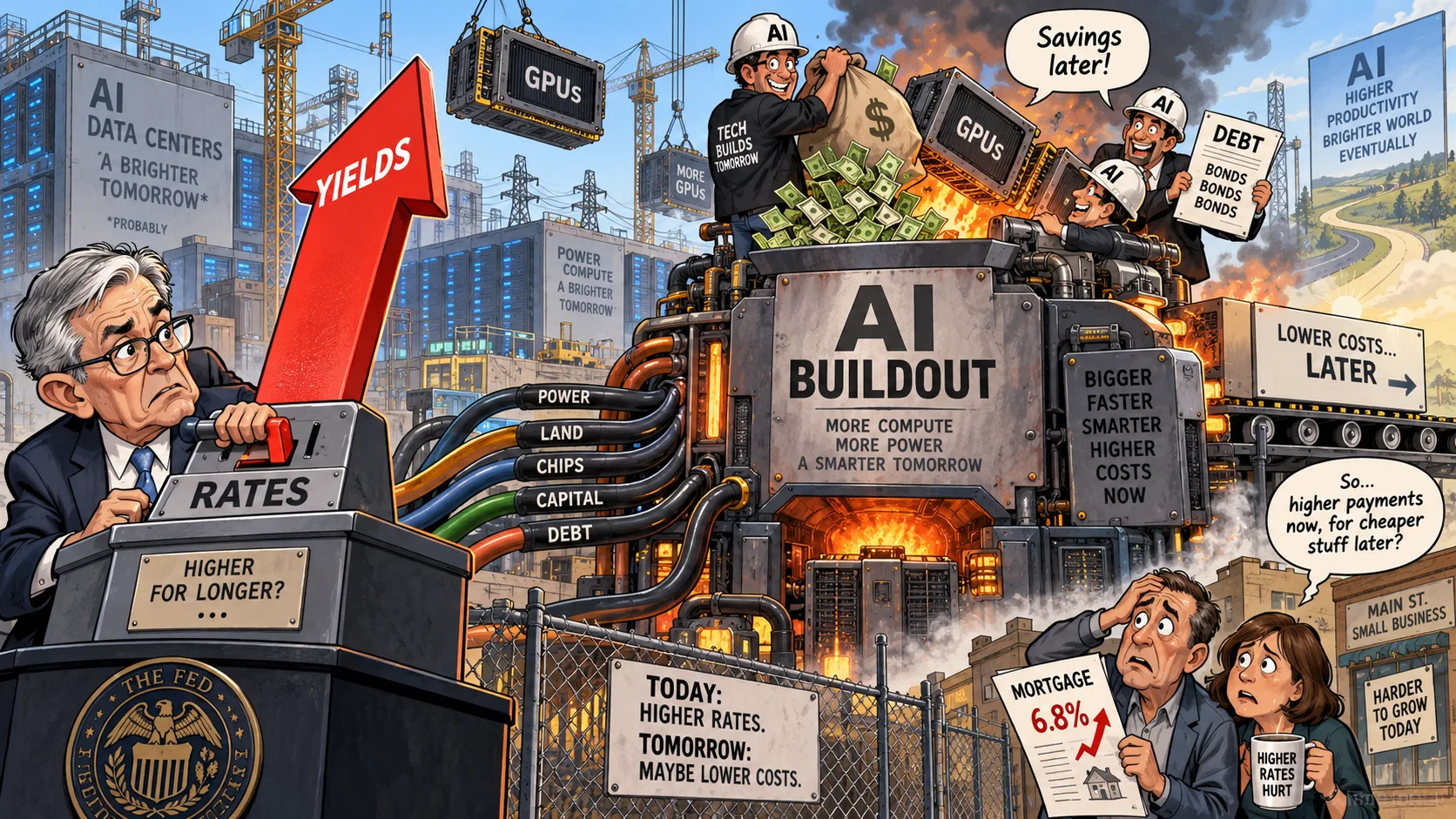
The bill for the buildout is coming due before the productivity gains it promises.

The long-term economic promise of AI is straightforward. More output. More productivity. Lower marginal costs. But getting there is proving extremely expensive.

Hyperscalers are building data centres, buying GPUs, securing electricity and issuing debt at extraordinary scale. This week alone, ByteDance secured a $29.6bn loan, Anthropic was finalising a $15.0bn revolving credit facility, and AI infrastructure company Nscale was seeking another $3.5bn ahead of an IPO.

That money has to come from somewhere. And increasingly, economists think the AI investment boom may be contributing to a higher neutral interest rate, or R-star: the theoretical rate at which monetary policy neither stimulates nor restricts the economy.

The New York Fed's model puts U.S. R-star at around 1.65%, up from 1.36% in early 2025. Market participants argue the true rate may be higher still because AI investment and government borrowing are simultaneously competing for huge pools of capital.

That produces an interesting contradiction. AI may ultimately be deflationary. But before it makes goods and services cheaper, the infrastructure required to build it may make capital more expensive.

If data centres, hyperscalers and governments are all issuing debt at the same time, investors can demand higher returns. Mortgage rates rise. Infrastructure projects become harder to finance. Companies outside AI face a higher hurdle rate even though they receive none of the immediate productivity benefit.

The eventual payoff could reverse the effect. If AI materially raises productivity and pushes operating costs lower, inflation could fall and equilibrium interest rates could eventually follow.

But that is the second act. We are currently paying for the first. This matters because investors often treat AI's economic benefits as though they arrive simultaneously with the spending. They do not. Capital expenditure happens today. Productivity gains arrive later, and nobody yet knows how large they will be or who will capture them.

Our view

AI may eventually make intelligence abundant and economic activity cheaper. But building the infrastructure underneath it requires a historic mobilisation of capital. Before AI lowers the cost of everything else, it may first raise the cost of money.

The Thinking Corner

If a technology ultimately promises lower costs and higher productivity, but reaching that future requires trillions of dollars of capital today, how should investors decide whether higher interest rates are simply the price of getting there or a threat to the investment case itself?

From The Felix View

Latest from the team

Market commentary and field notes from the team, on The Felix View.

Get Noise to Signal in your inbox.

One email a week · every figure sourced · unsubscribe any time

The securities referenced do not represent buy or sell recommendations. These notes describe corporate events and possible catalysts only. Figures are sourced from public filings, company presentations and market data; every claim links to its source. Prepared for institutional research use.

Vol. 1
2026-09-08 · UTC−08:00