
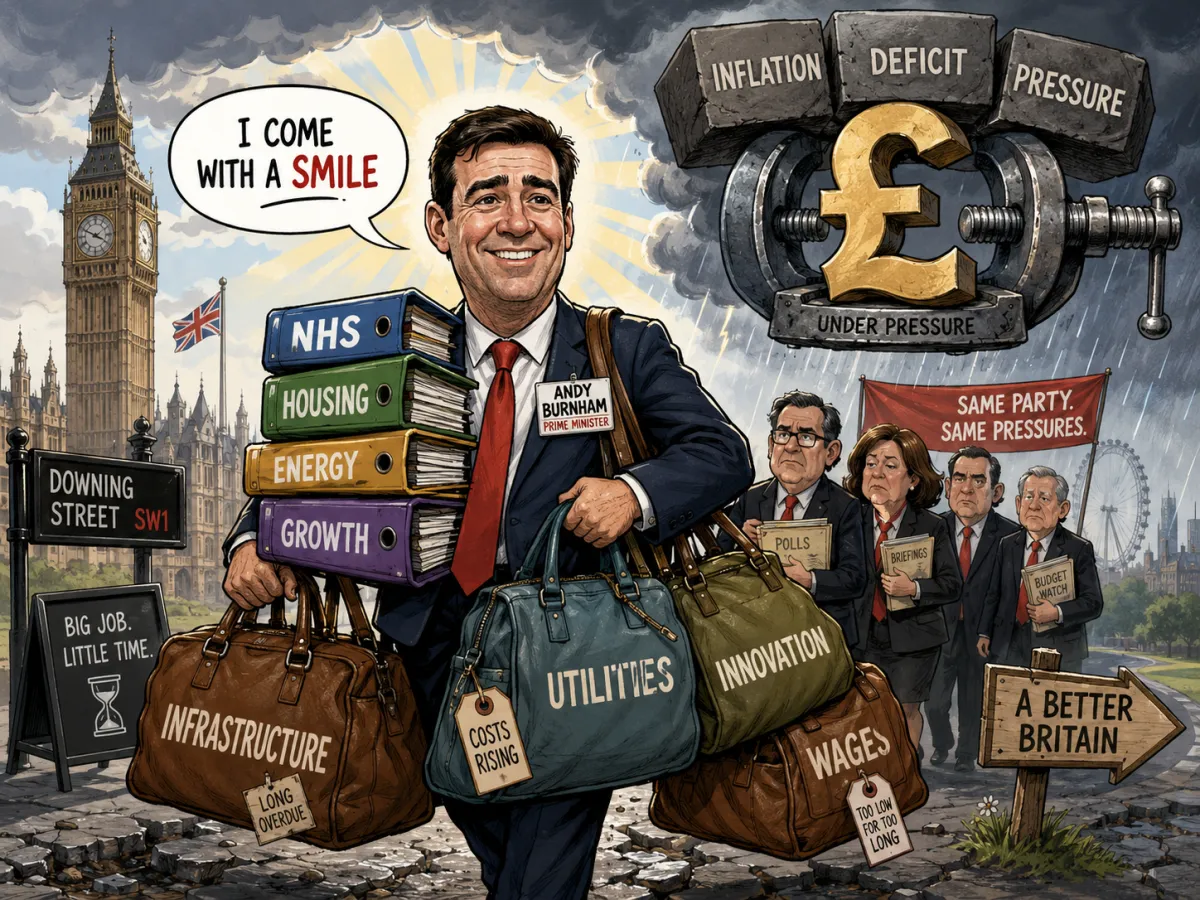
In case you haven't heard, Britain has a new Prime Minister. Andy Burnham arrives with something politics has been short of recently: warmth, plain speaking and the promise of a reset. Tone is not policy, but it can change the temperature. After years of churn, frustration and exhausted public services, a leader who sounds more connected to ordinary life may buy the government some political oxygen. Perhaps this is part of the reason why the typically quite tough British media is, at least, giving the new Prime Minister a chance before telling us why he, too, is not adequate. A welcome respite.
And timing matters. Burnham is arriving mid-parliament, not at the start of a fresh mandate. That gives him enough time to shift tone and maybe reset priorities, but not unlimited time to prove delivery before the next election cycle starts to dominate behaviour again.
The bigger question is what he can actually do with it. Burnham inherits a country that cannot be magically fixed by vibes alone. It needs productivity, growth, housing, infrastructure, innovation, NHS capacity, cheaper energy, functioning utilities, fiscal credibility and a clearer sense that government can, and wants to, deliver. None of those are quick fixes. None are solved by a leadership change on its own.
There is also a harder political question: this is still the same party in government. Many of the people are the same, some, like Angela Rayner, are coming back from exile. The constraints are the same. The fiscal inheritance is the same. The public-sector pressures are the same. The electorate may welcome a new face, but it will soon ask whether this is a genuine change in direction or just a change in presentation. The public, and public markets, are weary of empty promises.
The smile helps, but it is not the investment case. The real test is whether Burnham, the self-proclaimed "pro-business Prime Minister", can turn political curiosity into operational credibility quickly and decisively enough, before voters and markets lose patience. Can he simplify the agenda? Can he make hard trade-offs? Can he show progress on the issues people actually feel every month: bills, housing, transport, healthcare and wages, in a format that markets can stomach, or even support?
Markets and voters do not need a perfect answer immediately. But they do need evidence that the government is asking the right questions.
A reset is useful. A plan is better. Delivery is the only thing that compounds.
Macro
The macro backdrop, theme by theme — and our read.
Public markets
M&A
Staying Diligent
Things we are watching this week: 20-24 July 2026.
- Global flash PMIs The week's broadest real-time test of the growth outlook. Friday's readings from the U.S., UK, eurozone, Germany, France and Japan should show whether activity is stabilising or whether weakness is spreading across regions and sectors. The detail on new orders, employment and input prices will matter as much as the headline numbers.
- ECB decision The main policy event of the week. The ECB must balance weak regional growth against inflation risks from energy and supply disruption. A more hawkish message would raise the risk that monetary policy remains restrictive precisely as the eurozone economy loses momentum.
- UK labour market Employment, unemployment, vacancies and wage growth will help determine whether the UK slowdown remains orderly. Gradual wage moderation would give the Bank of England more flexibility; a sharper deterioration in hiring would point to a more concerning loss of economic momentum.
- UK retail sales Another test of whether the consumer can continue supporting growth. The key distinction is between households spending more and households actually buying more: resilient nominal sales are less reassuring if volumes remain weak or are being supported by temporary factors.
- China's policy response China left its benchmark lending rates unchanged after second-quarter growth slowed to 4.3%. That puts more pressure on fiscal measures and targeted support to revive domestic demand. Without a stronger consumer or property response, China may remain dependent on exports and industrial policy rather than a broad-based recovery.
- U.S. labour and housing Weekly jobless claims and new-home sales provide useful checks on two rate-sensitive parts of the economy. A gradual cooling would support the soft-landing narrative; a simultaneous weakening in employment and housing would be harder to dismiss as healthy normalisation.
- Alphabet, Tesla, IBM and Intel This week's earnings are also macro data. Alphabet and IBM should provide evidence on enterprise spending and AI investment, Intel on semiconductor and industrial demand, and Tesla on the consumer's appetite for expensive discretionary purchases. The market needs to see that investment and demand are producing revenue, not simply higher capex. Our view: Alphabet remains a particularly interesting bellwether for the current AI investment cycle, as the player that has most irons in the fire, across data, own models, partnerships and a potentially ever larger role offering TPUs and compute to new customers.
- Oil and bond yields Energy volatility remains one of the clearest threats to the growth outlook. Higher oil prices can weaken household demand while keeping inflation and long-term yields elevated — a combination that leaves central banks with less room to support slowing economies. Must be nice to be a vol trader these days.
- Growth breadth Watch whether economically sensitive sectors, smaller companies and lower-quality credit participate in any market strength. If the indices rise while cyclicals, small caps and credit spreads remain cautious, markets may be pricing resilience at the headline level without confirming it underneath.
Unhedged Commentary
When bonds stop being boring
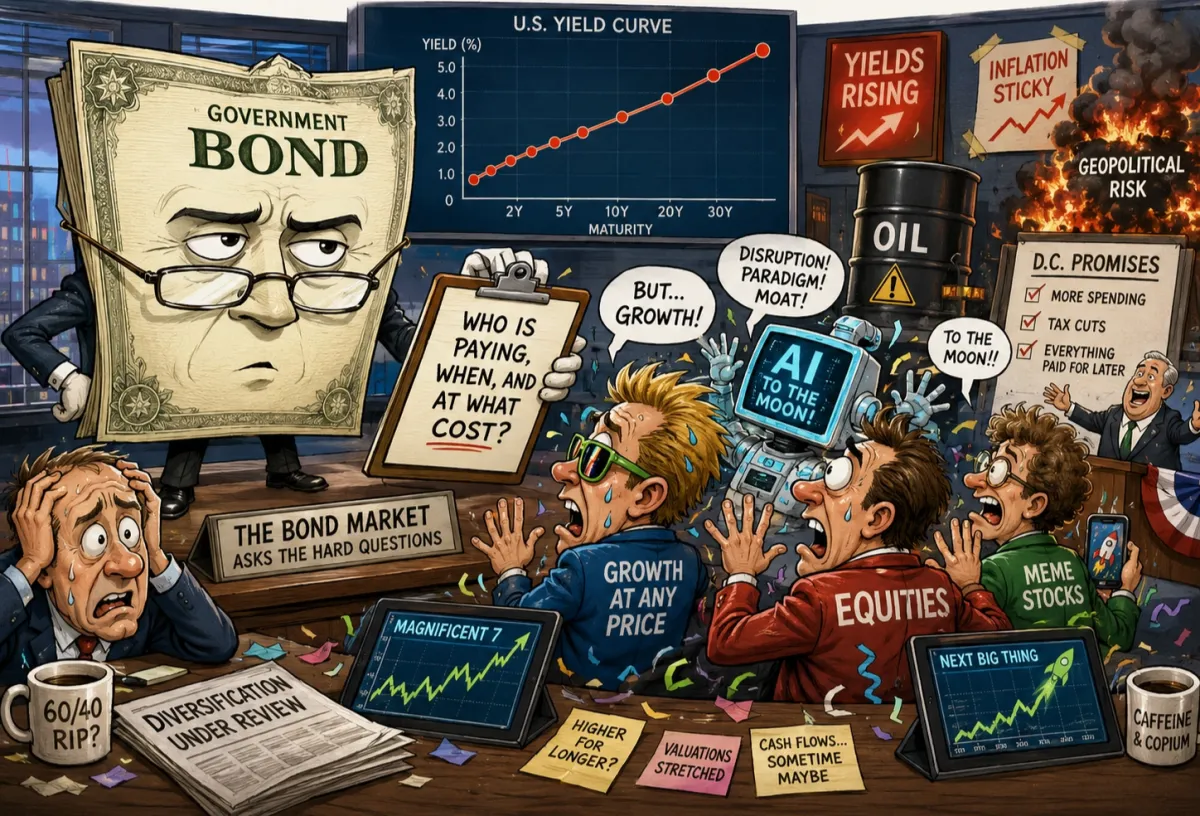
Equity markets get the headlines. Bonds usually get the footnotes. That works until the footnotes start moving the whole page. For the past few years, investors have been able to talk about AI, earnings, M&A and growth as if the bond market was just background music. But bonds are not background music. They are the price of money, the price of time and, increasingly, the price of credibility.
That is why the recent move in yields matters. Oil and gas prices have risen again due to the Iranian conflict, geopolitical risk is back in the macro conversation, and investors are being reminded that inflation is not only a domestic data point. It can also arrive through energy, supply chains, shipping routes and fiscal responses.
When that happens, bonds stop being boring very quickly. Higher yields do not just affect bond investors. They change the discount rate for equities. They increase government interest costs. They make refinancing more expensive. They pressure leveraged companies. They test housing markets. They force investors to ask whether growth stories are still worth the same multiple when safe assets pay more.
This is the part equity markets sometimes forget. A company can report decent earnings and still struggle if the rate used to value those earnings moves against it. A government can announce ambition and still be questioned if the bond market doubts the funding path. A consumer can keep spending for a while, but mortgages, credit cards and energy bills eventually have a vote.
The market's current tension is simple. Equities want to believe in earnings resilience and AI-led growth. Bonds are asking whether inflation, fiscal pressure and energy risk are being underpriced. Both cannot be ignored.
This does not mean a bond market crisis is the base case. It does not mean equities have to fall simply because yields move higher. But it does mean that the market's lie detector may not only be earnings season. It may also be the long end of the curve.
If long-term yields rise because growth is improving, markets can usually live with that. If they rise because inflation risk, fiscal credibility and geopolitical pressure are returning, that is a very different message.
Bonds are becoming more important, not less. They are where energy shocks, fiscal promises, inflation expectations and policy credibility meet. In a market full of exciting stories, the bond market is the less glamorous adult in the room asking who is paying, when, and at what cost. That question is boring only until the answer changes.
In Other News

The team that became a winning machine
Spain are world champions again. The immediate story is simple enough: Spain beat Argentina 1-0 in the 2026 World Cup final, with Ferran Torres scoring the winner in extra time. It is Spain's second World Cup, and another major trophy added to a run that has become difficult to dismiss as just a golden generation. Spain delivered a performance across the tournament of a team truly deserving the win, conceding just one goal throughout the tournament, and offering up moments of genuinely beautiful football.
The longer story is more interesting. Before 2008, Spain's senior men's national team had won one major trophy: the 1964 European Championship. A country full of talent, clubs, history and expectation, but not many medals at international level.
Since 2008, Spain have become a winning machine. Euro 2008. World Cup 2010. Euro 2012. Nations League 2023. Euro 2024. World Cup 2026. Six major trophies in less than 20 years, after winning only one before.
That kind of change does not happen because of individual brilliance alone. Spain are not short of individual quality, but much like the 2014 German squad, what delivered the victory ultimately was that the team plays like a TEAM. Structure that survives substitutions. Principles that survive pressure.
Spain leave New Jersey triumphant because there is a system behind the talent: technical development, positional discipline, comfort on the ball, pressing intelligence, role clarity and a national football culture that knows what it wants to be. Players are not just selected because they are good. They are selected because they fit, and understand, the system.
There is a business lesson here. Many companies have talented people. Fewer have principles clear enough to make those people better together. Fewer still have a structure that survives stress, growth, leadership changes and competitive pressure. The best organisations do not suppress individuality, but they do channel it. They make the whole more valuable than the sum of the parts.
Spain's lesson is not that genius does not matter. It is that genius compounds faster when it has a framework. The trophy belongs to the players. The machine belongs to the principles.
The Thinking Corner
When a new leader arrives with better tone and fresh energy, what evidence should we look for before calling it a real change rather than a change in presentation?
Latest from the team
Market commentary and field notes from the team, on The Felix View.