Noise to Signal·Vol 1·Issue 08·Week of Aug 31, 2026

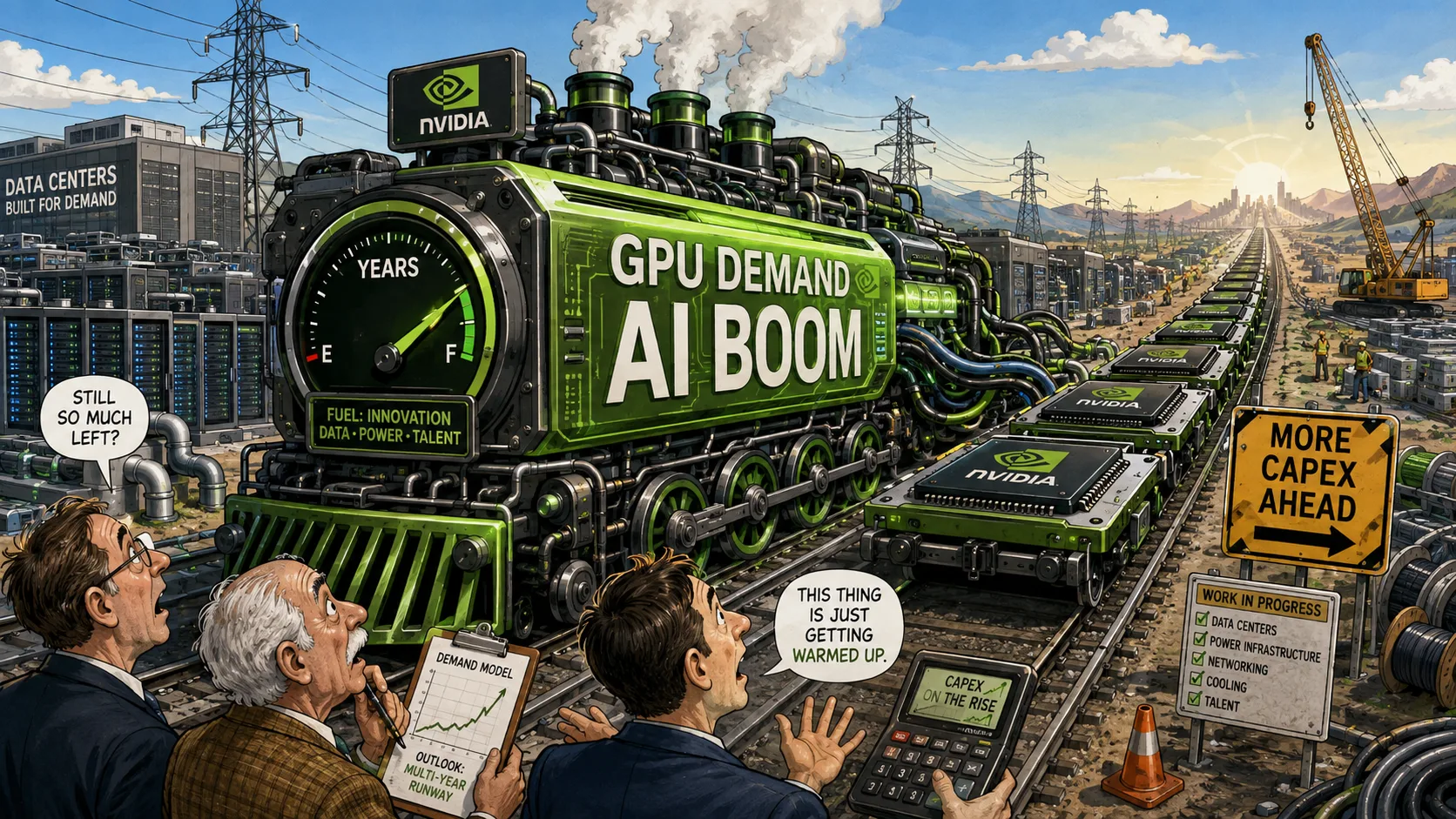
Nvidia says the AI boom has years left.

Nvidia guided to roughly 70% revenue growth next year and locked in 2 million GPUs with Amazon — why the AI investment cycle looks far from peaking, and what could still go wrong.

The data centre buildout keeps climbing — Nvidia says the runway is measured in years, not quarters.
Vol 1, Issue 08The data centre buildout keeps climbing — Nvidia says the runway is measured in years, not quarters.
The Brief

Nvidia just made the strongest case yet that the AI investment cycle is not close to peaking.

Quarterly total revenue more than doubled to $96.2bn, and the company now expects revenue to grow roughly 70% next fiscal year, far ahead of Wall Street's prior expectations. Demand is broadening beyond hyperscalers to sovereign buyers, enterprises and new cloud providers, while Nvidia remains constrained by memory and other components.

That matters because the central question around AI has changed. A year ago, investors were asking whether demand was real. Now they are asking whether demand can stay strong enough to justify the hundreds of billions being spent on data centres, power, networking and chips.

Nvidia's answer is yes. The company also expects its next-generation Vera Rubin processors to contribute meaningfully, while Amazon has agreed to deploy 2 million Nvidia GPUs by 2028.

The risk is no longer lack of demand. It is whether the economics of the entire ecosystem can keep pace with the scale of investment. Margins are already under pressure from higher component costs, and China remains largely absent from Nvidia's outlook because of export restrictions.

Our brief

Nvidia is telling investors that AI is not a one-cycle boom. If it is right, the more important question becomes who earns an attractive return on all the infrastructure being built around it.

Macro

Factor / ThemeOur read
U.S. inflationnot going quietly
Our readJuly PCE inflation rose 0.2% month-on-month and 3.7% year-on-year, slightly hotter than expected, while Q2 GDP remained at 1.5% annualised. The economy is slowing without giving the Fed the inflation relief it wants.
FedWarsh removes the comfort blanket
Our readKevin Warsh used his first Jackson Hole speech as Fed chair to reiterate the 2% inflation target and warn that further tightening may be required. Markets took notice: expectations of a September hike moved sharply higher. Less forward guidance means markets have to do more of the guessing themselves.
Australiainflation refuses to behave
Our readJuly CPI rose 1.0% month-on-month and 3.5% year-on-year, above expectations. More importantly, trimmed-mean inflation remained at 3.6%. Markets responded by sharply increasing the probability of another RBA hike. Australia has weakening housing and employment alongside sticky inflation: an uncomfortable combination.
South Koreagrowth gives the BOK permission
Our readThe Bank of Korea raised rates for a second consecutive meeting to 3.0% and upgraded its 2026 growth forecast from 2.6% to 3.3%. Strong exports and semiconductor demand are giving policymakers room to address inflation and financial-stability risks without sacrificing growth.
Chinatwo economies in one
Our readChinese industrial profits grew 11.2% in July, but the composition tells the real story. Electronics and AI-linked export sectors continue to boom while consumer-facing and property-related businesses remain under pressure. China's industrial strategy is working better than its domestic-demand strategy.
UKenergy shock, limited contagion so far
Our readAt Jackson Hole, Andrew Bailey said the latest energy-price shock has so far produced subdued second-round inflation effects, helped by a softer labour market. That is encouraging, but also fragile: another sustained rise in energy prices could quickly change the calculation for the Bank of England.

Public markets

Name / ThemeWhat happenedOur read
Nvidiayears, not quarters
What happenedNvidia beat expectations, with data-centre revenue rising 117% to $89bn, and guided to roughly $108bn of Q3 revenue. More strikingly, management forecast around 70% revenue growth next fiscal year.
Our readNvidia is telling investors that the AI infrastructure cycle has years left. The debate is moving from whether demand exists to whether everyone building around it can earn an adequate return.
Marvellthe revenue is coming... eventually
What happenedMarvell raised its fiscal 2027 and 2028 revenue targets, but shares fell more than 8% as investors learned that meaningful revenue from its huge Google custom-chip agreement may not arrive until fiscal 2029.
Our readAI investors have developed a short attention span. A potentially enormous contract is no longer enough; the market wants the earnings contribution quickly.
Alibabafund the boom first
What happenedAlibaba launched a $10.2bn discounted share sale to help finance its AI ambitions, sending the shares sharply lower. The company is already spending aggressively on compute after committing RMB380bn to AI infrastructure through 2029.
Our readThis is the other side of the AI boom. Demand may be enormous, but someone still has to finance the infrastructure before the revenue arrives. Existing shareholders increasingly get to help.
Unitreegravity returned
What happenedAfter surging more than fivefold on debut, Unitree shares subsequently fell roughly 45% from their initial spike.
Our readThe robotics story did not change in a week. The price did. That is a useful distinction between excitement about an industry and knowing what an individual company is worth.
Pernod Ricardpremium meets pressure
What happenedPernod Ricard reported weak sales in both China and the U.S., cutting expectations towards the bottom of its medium-term growth range while pursuing a €1bn restructuring programme. Shares fell after the update.
Our readPremiumisation works brilliantly until the premium consumer becomes cautious. Pernod now needs cost discipline without starving the brands that create its pricing power.
Pasqalquantum gets its IPO moment
What happenedFrench quantum-computing company Pasqal surged as much as 73% on its Nasdaq debut following a SPAC combination that valued it at around $2bn.
Our readAI enthusiasm is spilling into the next generation of computing. The commercial revenues remain small, but public markets are increasingly willing to finance technologies whose payoff sits much further out.

M&A

Name / ThemeWhat happenedOur read
NvidiaHugging Face
What happenedNvidia reportedly agreed to acquire open-source AI platform Hugging Face for $12.9bn.
Our readNvidia is moving further up the stack. Owning GPUs is valuable; owning part of the ecosystem through which developers discover, train and deploy models may be even more strategically useful.
Ursa MajorSPACs find defence
What happenedHypersonic-engine and missile supplier Ursa Major agreed to go public through a $2.3bn SPAC merger, including a $350mn PIPE.
Our readThe SPAC structure has found a category investors are willing to finance again: defence technology with visible government demand and significant manufacturing requirements.
SolsticeElement Solutions
What happenedThe two companies abandoned their proposed $14.5bn merger after shareholder feedback, with Solstice shares jumping following the cancellation.
Our readSometimes the best deal is the one management agrees not to do. Investors effectively argued that both businesses had more attractive standalone upside than the proposed combination recognised.
JD.comCeconomy
What happenedJD.com's $2.5bn acquisition of German electronics retailer Ceconomy remains caught in EU scrutiny over foreign subsidies, with Beijing now directly challenging the investigation.
Our readM&A is becoming another front in geopolitical competition. The commercial merits of a transaction increasingly matter alongside the nationality and perceived state support of the buyer.
H.B. Fulleractivism turns into an offer
What happenedActivist investor Ancora offered as much as $1.2bn for H.B. Fuller's Building Adhesives Solutions business after unsuccessfully opposing another acquisition by the company. Fuller rejected the approach.
Our readActivists increasingly need to do more than demand a sale. In a slower private-equity market, they may have to bring a buyer, or become one themselves.

Staying Diligent

Things we are watching this week: 31 August–4 September:

Event / ThemeWhy we care
U.S. payrollsthe September Fed decision
Why we careFriday's employment report is the main event. Economists expect only around 55,000–60,000 new jobs, after July unexpectedly lost jobs. Another weak print would make a September rate hike much harder to justify; a strong rebound would reinforce Warsh's hawkish Jackson Hole message.
JOLTS + ADP + ISMthe build-up to payrolls
Why we careTuesday through Thursday bring job openings, private payrolls and manufacturing/services surveys. With inflation still high, the Fed needs to know whether labour demand is genuinely cooling or July was simply noise.
BroadcomNvidia's second opinion
Why we careBroadcom reports on Wednesday 2 September. Nvidia showed that AI infrastructure demand remains enormous; Broadcom can tell us how much of that spending is moving towards custom accelerators and hyperscaler-designed silicon.
Eurozone inflationSeptember ECB hike?
Why we carePreliminary August inflation arrives Tuesday. Energy prices have pushed inflation higher again, and markets increasingly expect the ECB to tighten in September. The key question is whether the energy shock is also beginning to feed into core prices.
New Zealandanother central bank joins the hike cycle
Why we careThe RBNZ meets Wednesday with inflation currently at 4.1% and markets expecting another increase from the current 2.5% cash rate. New Zealand is another reminder that the global conversation has shifted surprisingly quickly from cuts back towards tightening.
Bank of Canadawait and see
Why we careCanada also decides rates Wednesday, but economists unanimously expect a hold at 2.25%. Trade uncertainty and softer demand argue for patience even as inflation sits near the top of the target range. Two central banks meeting on the same day may reach different conclusions from the same global inflation shock.
Oilthe unscheduled data release
Why we careRenewed U.S.–Iran fighting pushed Brent back above $90 as the week began. Oil remains capable of rewriting every central-bank forecast above in real time.

Unhedged Commentary

Your AI supplier can become your competitor overnight.
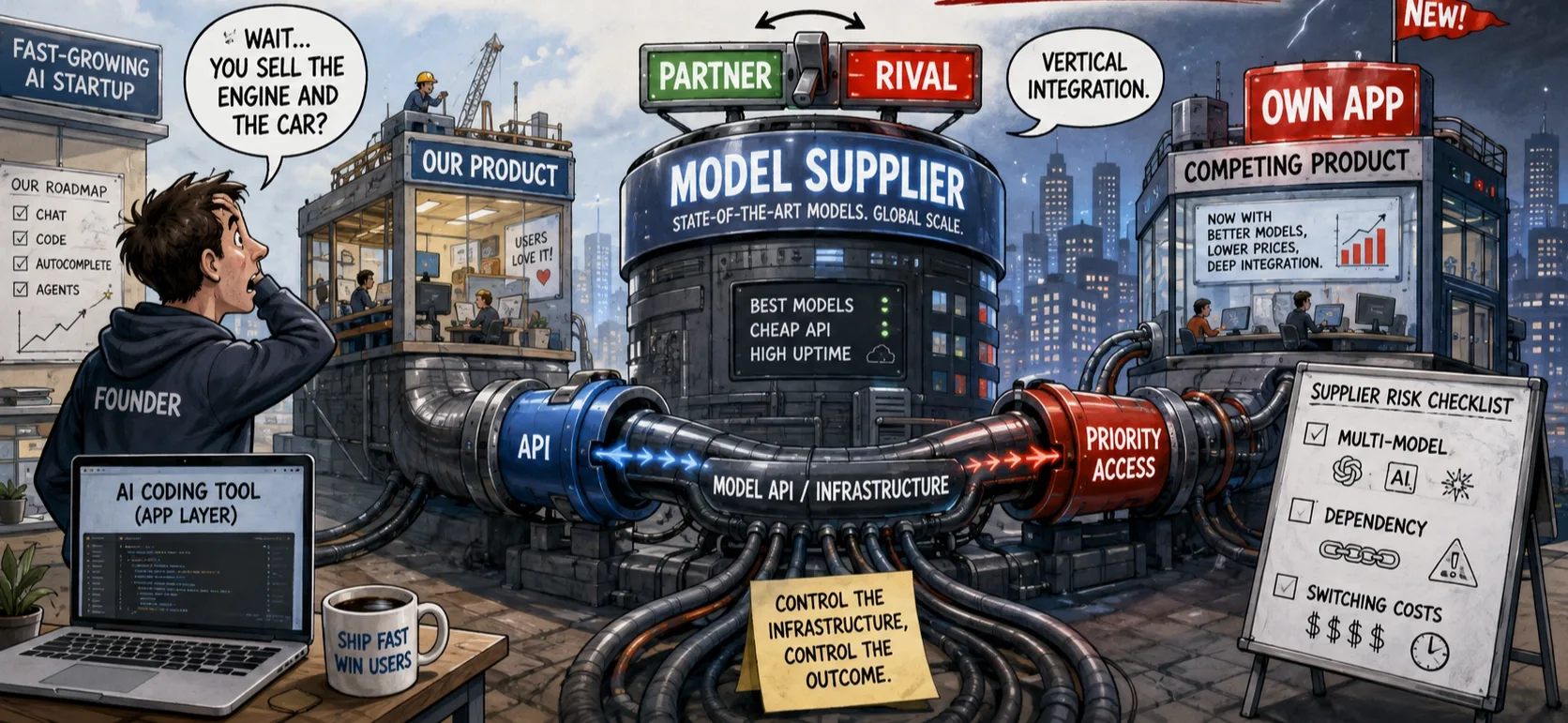
The vendor you built on can become the rival you compete with.

Cursor built one of the world's most successful AI coding tools partly by using models supplied by OpenAI. Then its owner changed. SpaceX acquired Cursor's parent company, and OpenAI subsequently said it plans to stop supplying Cursor with its models from November. Anthropic, meanwhile, is increasing support for the platform.

The corporate dispute is unusually colourful. The strategic lesson is not. Companies are increasingly building products on top of a handful of frontier AI providers. That looks efficient until your supplier acquires a competing product, changes its commercial priorities, becomes politically constrained or simply decides that your business is no longer strategically useful.

Cloud computing already taught companies the value of avoiding excessive dependency on one infrastructure provider. AI may make that lesson more urgent. The obvious response is multi-model architecture: design products so that OpenAI, Anthropic, Google or other models can be substituted without rebuilding the entire product. That may cost more in the short term. But dependency also has a price.

Our view

The frontier model is increasingly becoming critical infrastructure. If your product cannot survive your model provider changing its mind, you do not really control your product.

In Other News
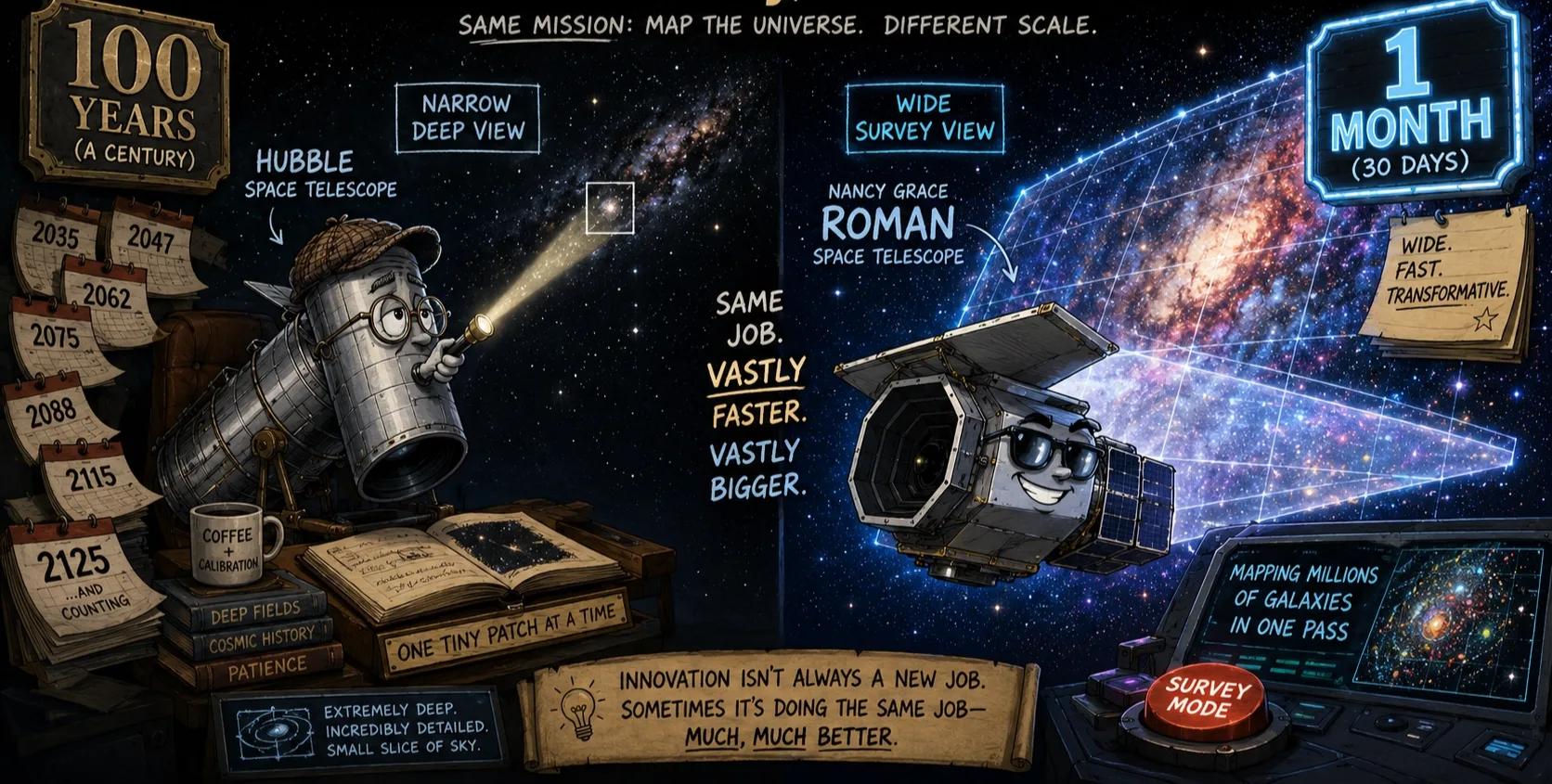
One month of Roman observations would take Hubble a century — scale as the disruption itself.

Hubble needs a century. Roman needs a month.

NASA launched the $4bn Nancy Grace Roman Space Telescope this weekend. Its mirror is roughly the same size as Hubble's. Its advantage is not that it can see dramatically further. It can see dramatically more.

Roman's wide-field camera can survey huge areas of the sky at once. One month of Roman observations of the Milky Way would take Hubble roughly a century to complete.

That is a useful business lesson. Innovation does not always mean doing something entirely new. Sometimes it means taking a job we already know how to do and changing its economics by two orders of magnitude. The internet did not invent shopping. Cloud computing did not invent computing. Streaming did not invent television. Their impact came from making familiar activities faster, cheaper or vastly easier to scale. Roman is similar.

Hubble remains extraordinarily valuable because it can spend long periods studying individual targets in exceptional detail. Roman does something different: it turns astronomy into a survey at a scale Hubble was never designed for.

The lesson: Disruption is not always about replacing the old technology. Sometimes it is about making one particular job so much faster that an entirely new set of possibilities becomes practical.

The Thinking Corner

When an industry is growing fast enough that suppliers, customers and competitors increasingly become the same companies, what evidence should investors look for to understand where the durable value will actually be captured?

From The Felix View

Latest from the team

Market commentary and field notes from the team, on The Felix View.

Get Noise to Signal in your inbox.

One email a week · every figure sourced · unsubscribe any time

The securities referenced do not represent buy or sell recommendations. These notes describe corporate events and possible catalysts only. Figures are sourced from public filings, company presentations and market data; every claim links to its source. Prepared for institutional research use.

Vol. 1
2026-09-01 · UTC−08:00